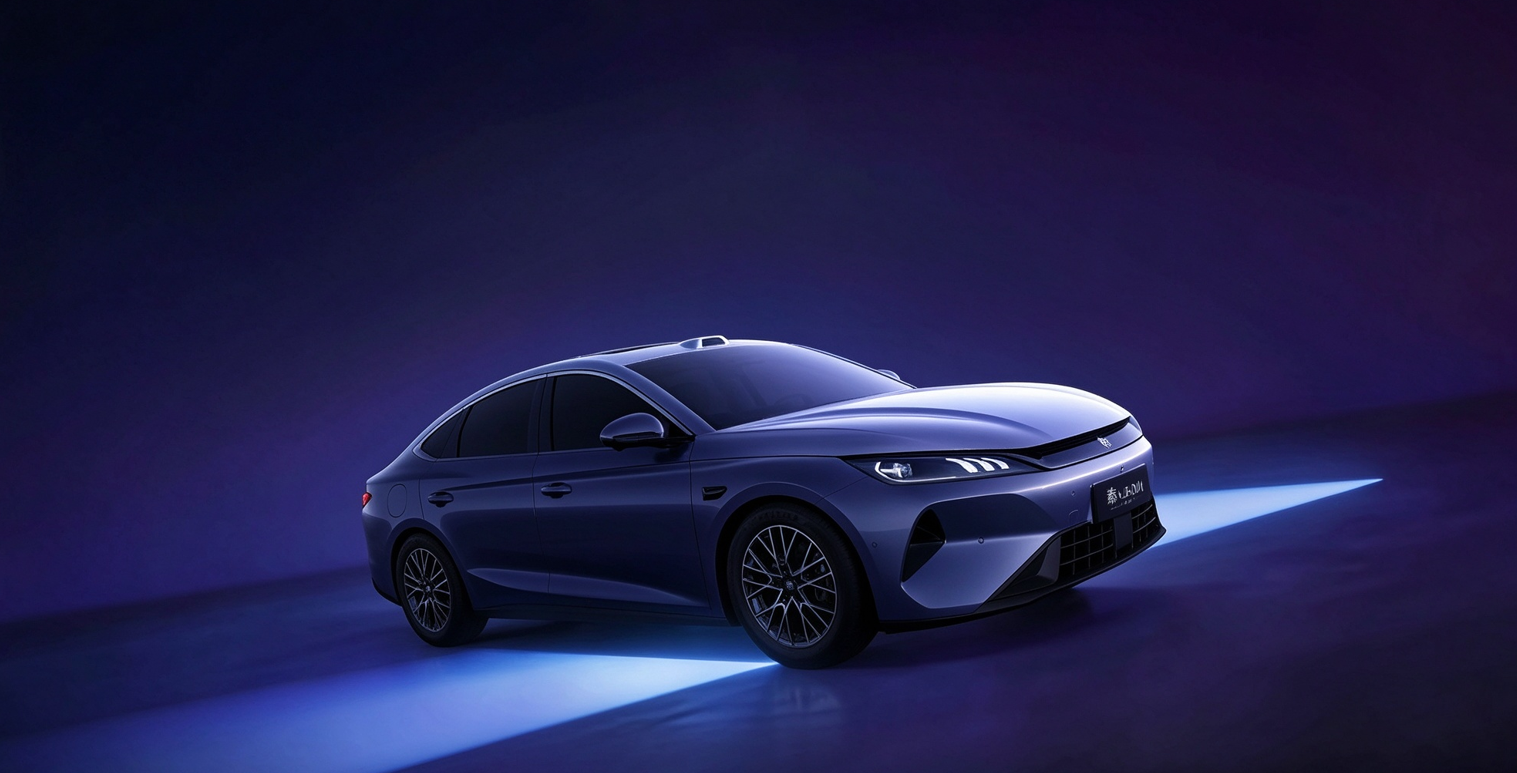
- BYD unveils Qin Max as a B-segment flash-charging sedan positioned above the Qin L.
- Qin Max offers BEV (120kW/240kW) and DM-i PHEV powertrains with second‑gen Blade Battery expected.
- Qin Max targets a RMB 130,000–170,000 gap to reclaim lost Qin sales amid fierce EV sedan competition.
On July 13, BYD officially previewed its all-new Qin Max sedan. As the latest addition to the Qin family, the model is positioned as a “B-segment flash-charging sedan.”
Lu Tian, general manager of BYD’s Dynasty Network sales division, said Qin Max will serve as the “top-spec” version of the Qin family, positioned above the current Qin L and designed to fill the gap in BYD’s mid-range sedan lineup.
Previously, the Qin L played a role in helping BYD expand upward in the RMB 100,000-150,000 ($14,760-22,130) sedan segment, while the Han series mainly targeted the RMB 180,000-250,000 ($26,570-36,900) market.

Following the recent report regarding the discontinuation of the Qin L, BYD’s Dynasty Network has seen a notable gap emerge in the RMB 130,000-170,000 ($19,180-25,080) price range, where Qin Max is expected to compete.
According to previously released filings with China’s MIIT, the Qin Max measures 4,866mm in length, 1,880mm in width, and 1,495mm in height, with a wheelbase of 2,820mm.
Compared with the Qin L’s 4,830mm length and 2,790mm wheelbase, the new model gains 36mm in overall length and 30mm in wheelbase, bringing its dimensions closer to traditional B-segment sedans.
In terms of powertrains, Qin Max will be offered with both battery-electric and plug-in hybrid variants.
The pure electric version will use BYD’s self-developed electric motor, offering two power outputs of 240kW and 120kW, and is expected to be equipped with the second-generation Blade Battery.

The plug-in hybrid version will feature BYD’s fifth-generation DM-i Super Hybrid system, combining a 1.5L naturally aspirated engine with an electric drive motor.
The engine delivers a maximum output of 74kW, while the electric motor produces up to 175kW.
Official teaser images show a lidar sensor mounted on the roof, suggesting that Qin Max may adopt a lidar-equipped version of BYD’s “God’s Eye B” advanced driver assistance system.
However, Qin Max will enter an increasingly competitive market. Competition in China’s RMB 100,000-200,000 ($14,760-29,500) new energy sedan segment has intensified in recent years.
Brands including Geely Galaxy, Changan Nevo, and Leapmotor have continued to launch new models, requiring BYD to maintain its advantage through clearer product positioning.
The model launch also comes amid changes in Qin family sales performance. As a key product line under BYD’s Dynasty Network, the Qin family was once one of the company’s major growth drivers.

Data showed that Qin family sales reached 68,450 units in June 2024.
By June 2026, however, sales of the Qin family, including the Qin PLUS and Qin L, had fallen to around 14,900 units, representing a decline of 78%.
In June this year, BYD’s Dynasty Network delivered 157,000 vehicles, accounting for nearly 40% of BYD’s total sales and remaining one of the company’s core volume contributors.
The arrival of Qin Max effectively completes the final piece of BYD’s B-segment sedan lineup, strengthening its presence in a highly competitive market between entry-level and premium EV models.
Discover more from ChinaEVHome
Subscribe to get the latest posts sent to your email.