- XPeng’s robotics unit raised over $900M, pushing its valuation past $6.3B in a record China deal.
- Funding will accelerate IRON humanoid mass production, global commercialization, and AI/hardware scaling.
- IRON targets 2026 mass production and 2027 global rollout to compete with Tesla Optimus.
On Aug. 24, XPeng announced its robotics business had raised more than $900M in its first funding round, pushing its post-money valuation to over $6.3B (approximately RMB 43B). The deal sets a new record for a single private-equity funding round in China’s embodied intelligence sector.
IDG Capital led the round, with GaoRong Capital participating. Tencent and Alibaba also joined as strategic investors. XPeng will retain control of the robotics business after the funding. The unit will remain part of XPeng’s consolidated financial statements.

XPeng said the funds will mainly support robotics hardware and software development, physical AI model training, high-quality data collection, mass-production base construction, and global commercialization.
After the funding announcement, XPeng CEO He Xiaopeng said the company hopes to bring advanced humanoid robots into real-world use in the near future.

He said IRON will become more human-like, safer, support natural interaction without a remote controller, and have its own memory. The goal is not to stop at demonstrations. XPeng aims to bring IRON into mass production, then into everyday life.
The funding comes as XPeng’s humanoid robot IRON enters a key pre-production phase. IRON has already started small-batch trial production at XPeng’s Guangzhou plant. Its mass-production line has entered final commissioning.

XPeng previously said it aims to start humanoid robot mass production in 2026, with IRON gradually entering XPeng stores and commercial settings worldwide from 2027 for sales support, product demonstrations, and other tasks.
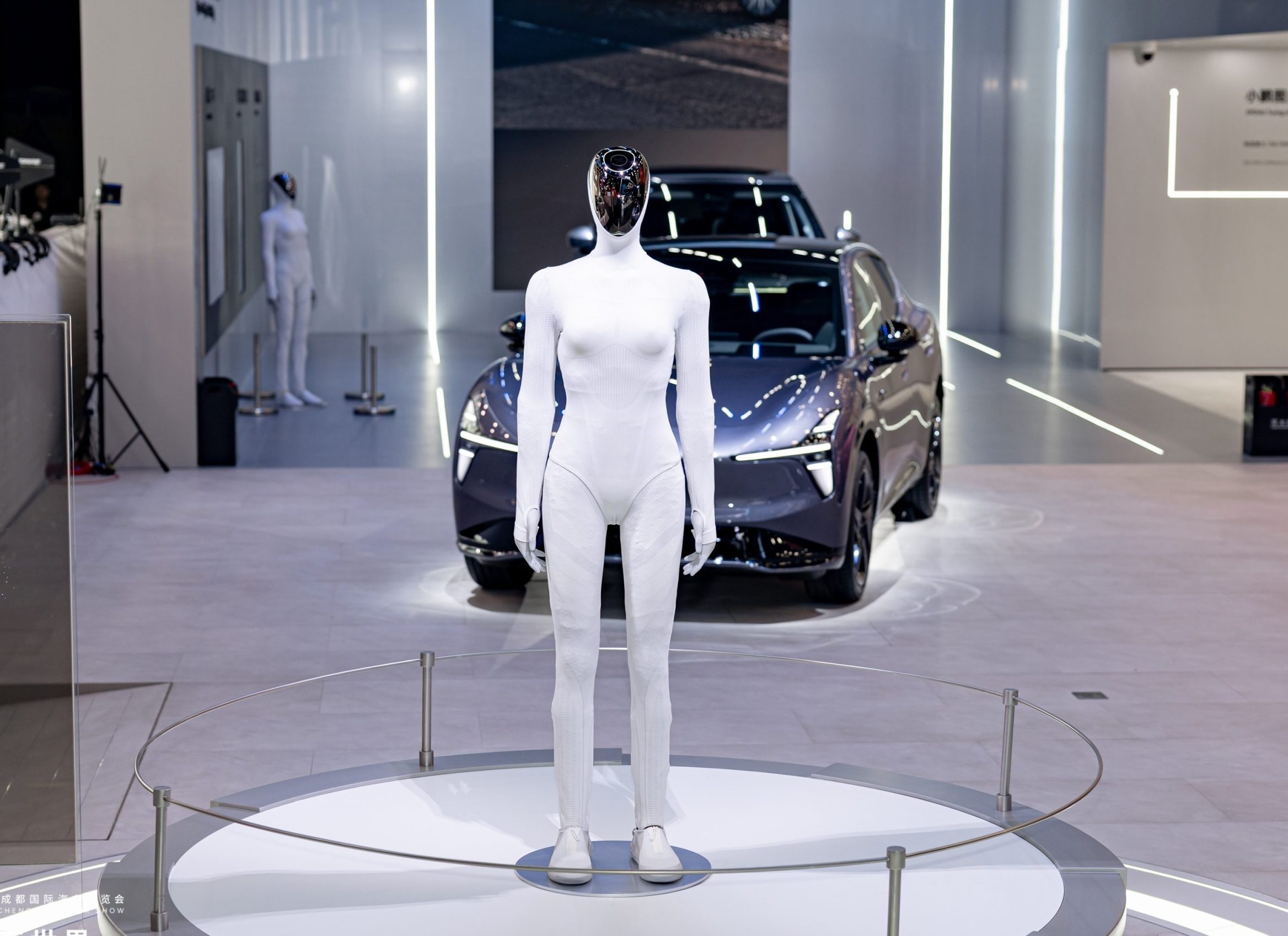
IRON first made its public debut at XPeng AI Day in November 2025. Its human-like walking gait drew attention. Some viewers even suspected a person was inside the robot. He Xiaopeng later showed IRON’s internal structure on site, demonstrating that the robot is driven by a mechanical system.
XPeng’s robotics business is now in its eighth year of development. He said the company has built eight generations of robots, starting with quadruped robots before gradually shifting toward humanoid machines.

He described IRON’s core capabilities across three areas: human-like body structure, automotive-grade safety and mass-production capability, and AI. AI is the key factor separating XPeng’s robots from traditional machines.
IRON uses three XPeng-developed Turing AI chips, delivering total computing power of 2,250 TOPS. It also connects to XPeng’s second-generation VLA large model. XPeng aims to combine its own chips, large model, and hardware systems to give IRON environmental perception, task understanding, and action execution capabilities rather than relying on remote control.
In other words, XPeng wants IRON to do more than walk. It aims to understand its surroundings, understand tasks, then complete actions autonomously.

For commercialization, XPeng is starting with its automotive stores and other commercial settings. The latest funding of more than $900M could help move the robotics business from a long-term R&D project toward scaled commercialization.
Under XPeng’s current plan, IRON will officially enter overseas markets in 2027. It will then face global competitors such as Tesla Optimus.
Discover more from ChinaEVHome
Subscribe to get the latest posts sent to your email.