- Beijing Hyundai launches IONIQ V Sept. 29 as its first China IONIQ model, signaling a push to regain share amid intense price and feature competition in the EV market.
- Variants offer rear single-motors at 140 kW and 168 kW, 0–100 km/h around eight seconds, 53.5 kWh and 66.8 kWh LFP batteries, CLTC 540–650 km, 800V fast charging.
- Targets compact family sedan rivals including domestic mid-size EVs and legacy entrants, but weak past sales, scaling, and mixed mass-market styling risk hampering execution.
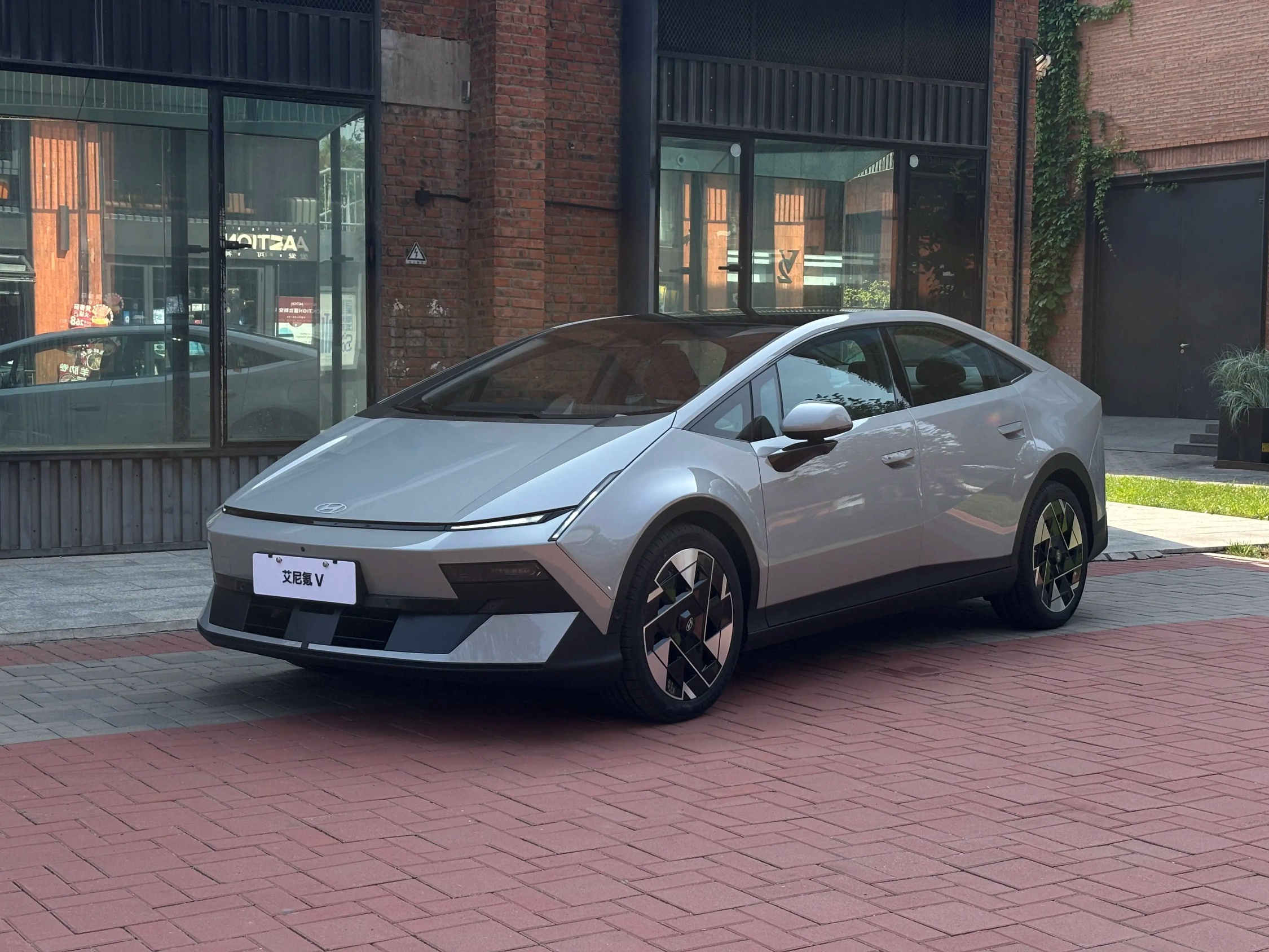
Beijing Hyundai announced that its new all-electric sedan, the IONIQ V, will officially launch on Sept. 29. The model opened pre-orders at the 2026 Chengdu Auto Show, with three variants priced from RMB 119.9K to RMB 139.9K ($17.9K-$20.9K).
As the first model from Hyundai’s IONIQ new energy brand introduced to the Chinese market, the IONIQ V is based on Hyundai’s E-GMP dedicated EV platform. The vehicle was developed under the leadership of Beijing Hyundai’s China Design Center and is planned for future overseas expansion.

Positioned as a mid-size electric sedan, the IONIQ V measures 4.9 m in length, 1.89 m in width and 1.47 m in height, with a 2.9 m wheelbase. Despite its low-slung fastback profile, the model is designed primarily for family use, focusing on interior space, comfort and everyday driving.
Design is the IONIQ V’s biggest highlight.
The vehicle adopts Hyundai’s ONE CURVED integrated curve design language, giving it a distinctive cyber-inspired appearance. A closed front fascia, split headlights, frameless doors, hidden door handles and a low-profile wedge-shaped body combine to create a highly recognizable look.
Compared with the increasingly similar designs seen across China’s new energy vehicle market, the IONIQ V takes a more aggressive styling approach. Some exterior details even resemble elements found on Lamborghini models.

However, such a highly personalized design comes with trade-offs. For consumers seeking a younger and more distinctive appearance, the styling could become a key attraction. For others, differences in aesthetic preferences may limit broader market acceptance.
Despite its sporty exterior, the IONIQ V adopts a more comfort-oriented powertrain setup.
The model offers two rear-mounted single-motor versions with outputs of 140 kW and 168 kW, with a 0-100 km/h acceleration time of around 8 seconds. Battery options include 53.5 kWh and 66.8 kWh lithium iron phosphate packs, delivering CLTC ranges of 540 km to 650 km. An 800V high-voltage fast-charging platform comes standard.
Inside, the IONIQ V features a minimalist, technology-focused cabin. It removes the traditional instrument cluster and comes with a 27-inch 4K central display, Qualcomm Snapdragon 8295P chip, AI large-model functions and Momenta’s advanced driver-assistance solution.

Beijing Hyundai’s transition into the new energy vehicle market has not been smooth amid China’s rapid EV growth.
In its early efforts, Beijing Hyundai launched models including the Encino Electric and Lafesta Electric. However, limited product competitiveness and smart features prevented them from gaining significant traction in China’s EV market.
Hyundai Motor Group later introduced its global E-GMP dedicated EV platform to China and launched the EO, its first electric SUV based on the architecture. The company hoped technologies such as an 800V high-voltage platform and long driving range would help it regain ground in the EV market.
Market performance, however, remained limited. After launching at the end of 2025, the EO sold only 558 units throughout 2025, with cumulative sales reaching 423 units from January to August 2026.

Beijing Hyundai is now seeking to reshape its EV strategy in China through the IONIQ brand. Under its plan, the company will launch multiple new energy models in China over the next three years, covering battery electric vehicles, extended-range EVs, sedans and SUVs. Beijing Hyundai has set a sales target of 500K vehicles by 2030.
Discover more from ChinaEVHome
Subscribe to get the latest posts sent to your email.