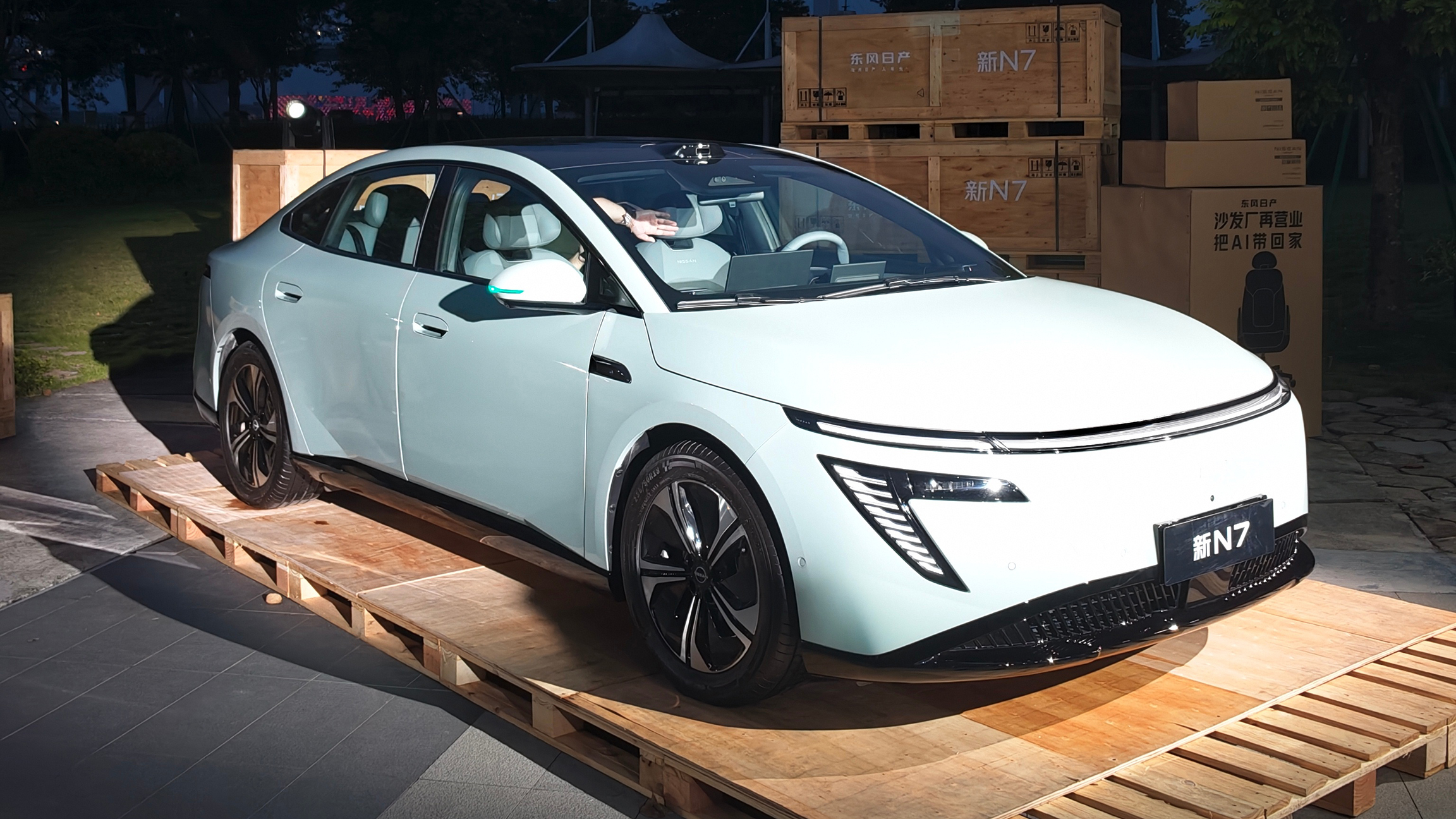
- Dongfeng Nissan cut the updated N7's entry price by RMB 10K to RMB 109.9K–RMB 146.9K ($16.4K–$21.9K) while adding a 625 Max Black Knight Edition.
- All Max trims now include LiDAR and an upgraded Qualcomm 8650P ADAS chip with 200 TOPS, Momenta R7 world model enabling urban NOA; Pro trims remain vision-only.
- Targets crowded RMB 100K–150K family EV segment against rapid local iterations, but falling monthly sales, supply scaling and shorter product cycles threaten meaningful recovery.
Dongfeng Nissan launched the updated N7 on Sept. 23, roughly 16 months after the model first went on sale.
The basic trim structure remains unchanged, with Air, Pro and Max versions, while a new 625 Max Black Knight Edition joins the lineup. With limited-time incentives included, the entry price is RMB 10K lower than before, putting the range at RMB 109.9K to RMB 146.9K ($16.4K–$21.9K).

The biggest changes are in the driver-assistance hardware.
All Max trims now come with LiDAR, while the ADAS chip has been upgraded to Qualcomm’s 8650P with 200 TOPS of computing power. The Momenta system also moves from its previous vision-based Flywheel model to the R7 world model, allowing urban NOA to operate without relying on pre-recorded routes.

Pro trims continue to use a vision-only setup, unchanged from the previous model.
Exterior changes are limited. The fully hidden door handles have been replaced by semi-hidden mechanical units to comply with updated Chinese regulations.
Wheel size has also been reduced from 19 to 18 inches. There are likely two considerations behind the change. Battery capacity is about 2 kWh lower than before, yet CLTC range remains unchanged, with the smaller wheels helping improve efficiency. The higher-profile tires should also provide better impact absorption and ride comfort, which fits the N7’s family-oriented positioning.

Comfort features have been expanded as well. The updated N7 adds ventilation and heating for the rear seats, while the hot-and-cold refrigerator remains optional. A heat-pump system is now available too, making the car better suited to colder northern regions.
The N7 also plays a broader role in Dongfeng Nissan’s EV plans.
It was the first model built on the Tianyan architecture, led by a China-based development team and drawing heavily on the local supply chain. Other N-series models, including the N6 and NX8, follow the same development, calibration and iteration process.

In that sense, the N7 has served as the starting point for Dongfeng Nissan’s latest NEV lineup in China.
Sales were strong in the months after launch.
The N7 peaked at 10,148 units in a single month, becoming the first JV-brand battery-electric model in China to cross the 10,000-unit monthly sales mark. At the time, it was widely seen as one of the more promising signs of progress from Japanese automakers in China’s EV market.
That momentum did not last.
Monthly sales have hovered just above 1,000 units for much of 2026, before falling below 1,000 in August.
The latest update is largely aimed at strengthening the existing package. But the RMB 100K–150K ($14.9K–$22.4K) EV market is far more crowded than it was 16 months ago. Chinese rivals are continuing to add more equipment at similar prices, while product cycles are getting shorter.
The refreshed N7 is more competitive on both price and equipment. Whether those changes are enough to lift sales will become clearer over the next few months.
Discover more from ChinaEVHome
Subscribe to get the latest posts sent to your email.