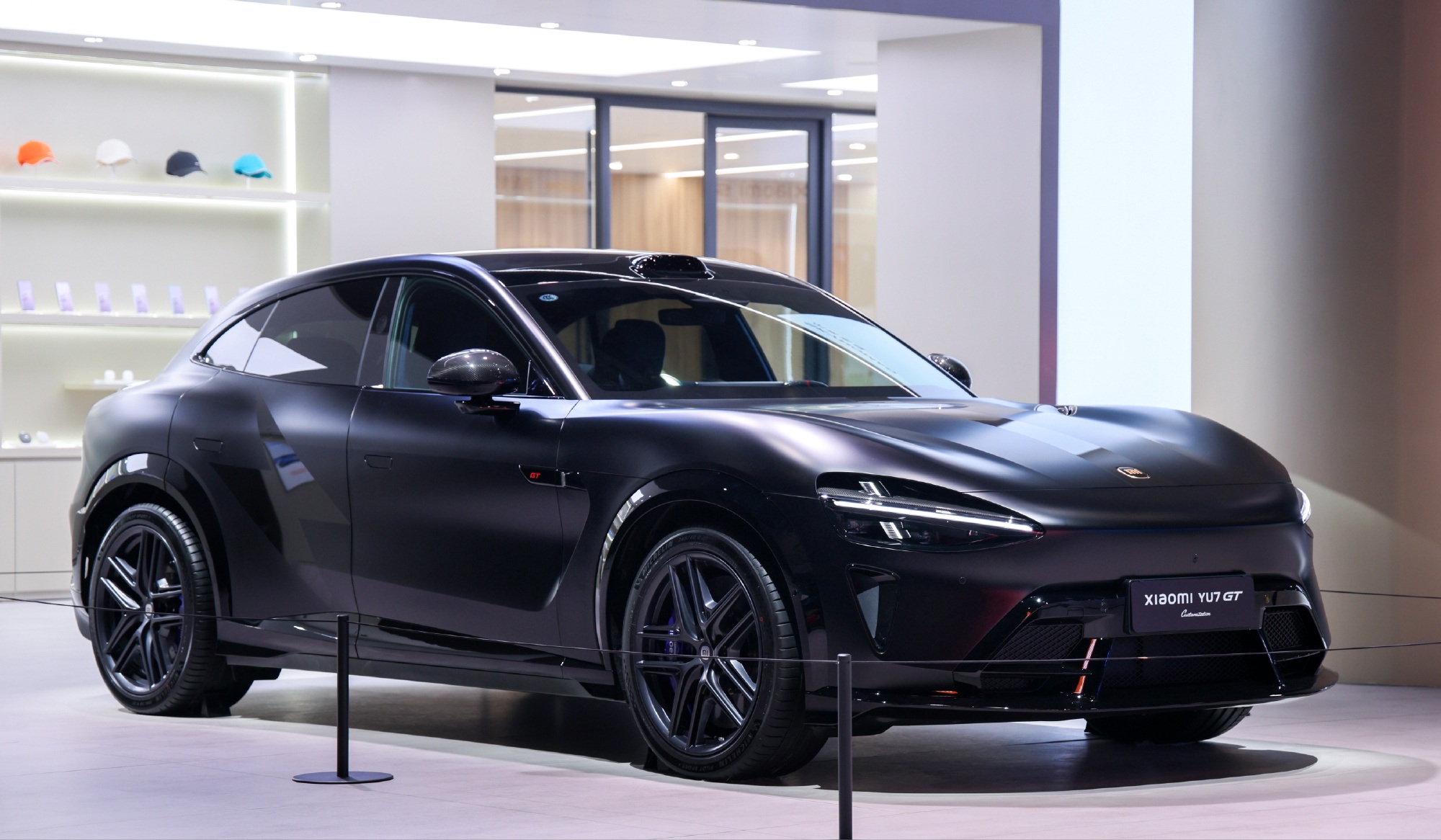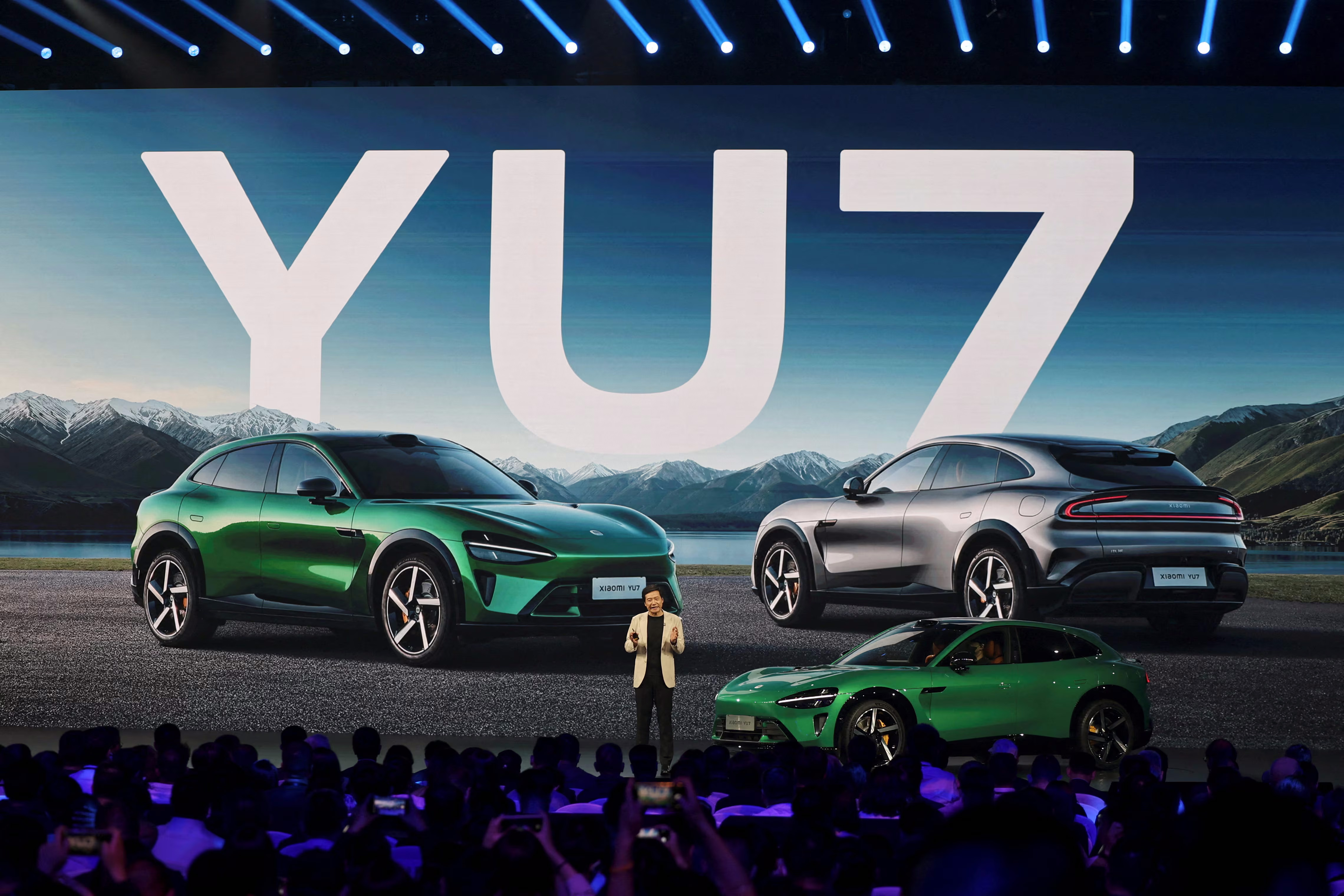
Xiaomi YU7 achieved record-breaking sales through Lei Jun’s leadership, core technology, emotional branding, efficient production, and consumer-focused innovation.
On the night of the Xiaomi YU7 launch, when the official poster reading “200,000 orders in just 3 minutes” was released, a media friend from a traditional automaker described her feelings as “devastated.”
She couldn’t understand how Xiaomi, a company that hadn’t even been delivering vehicles for two full years, could achieve 200,000 pre-orders (refundable within seven days) in 3 minutes, and 240,000 locked orders (non-refundable) within 18 hours.

This kind of performance can be considered a record high in the history of automotive development.
It was even more astonishing than the previous record—when Tesla launched the Model 3 in 2016, it secured 180,000 pre-orders worldwide in 24 hours.
“Impossible” was the instinctive reaction.
“It’s just marketing hype, or the numbers are fake,” was the reflexive rebuttal.
“Don’t bother learning from them; it can’t be replicated,” became the conclusion some auto industry insiders reached after reflection.
However, for Xiaomi, which only began deliveries in 2024, if the hot sales of its first model, the SU7, could still be dismissed as a “fluke,” then the performance of the YU7 is enough to prove that there must be some fundamental underlying logic driving Xiaomi’s success.
It’s precisely because of this that we said on Weibo (@电动星球小新): subconscious resistance, disbelief, suspicions of fraud, or envy—none of these reactions mean anything. Simply attributing the success to Lei Jun’s personal charisma is also wrong.
Wake up! Stop using “we can’t replicate it” as an excuse. To be blunt, perhaps the exact feeling Lei Jun wants you to have is “we can’t replicate it.”
But Lei Jun himself is very clear-minded: “The Model Y is truly an outstanding vehicle. Its position as the world’s best-selling car is absolutely not just because of Elon Musk’s personal brand. There are many things in it that are worth learning from.”
But what exactly can be learned from it? What is this so-called “underlying logic”?
Zotye’s Rise and Fall
When analyzing Xiaomi, one question must be addressed: Both Xiaomi and Zotye have faced accusations of “copying” designs—why did Zotye collapse into obscurity, while Xiaomi Auto has risen against the odds?
On platforms like Zhihu, this has become a hotly debated topic.
But before answering this question, one must first acknowledge a somewhat jarring fact: Zotye once enjoyed tremendous success.
In 2014, with its T600 SUV, whose design bore a striking resemblance to the Audi Q5, Zotye sold 166,000 vehicles in a single year. Media at the time commented: “Amid an overall slowdown in the growth of Chinese domestic brands, Zotye achieved a rare surge in sales.”
And the now-iconic slogan, “Driving a ‘Zorsche’ (Here, the letter “P” of Porsche is replaced by the letter “Z” of Zotye, indicating that Zotye copied Porsche), I’m the coolest guy in my village,” originated in 2016. That year, Zotye launched the SR9, a car that almost 1:1 replicated the Porsche Macan, catapulting the brand into the spotlight and helping its annual sales soar by 50% to 333,100 units, ranking it among the top ten domestic Chinese car brands.
What does 333,100 units mean? It was selling better than Xiaomi!
Xiaomi began deliveries in April 2024. According to Lei Jun’s statement during the New Year’s Eve livestream on December 31, cumulative deliveries stood at 135,000 units. The delivery target for 2025 was set at 300,000 units.
Back then, even some senior executives of domestic brands were deeply envious of Zotye.
Earlier this week, during a Geely Auto design training camp, a leading automotive journalist told us that years ago at an airport, he met a prominent auto executive who openly expressed admiration for Zotye—because Zotye was making real money.
The journalist remarked that in terms of capital and industry connections, Zotye was far inferior to Xiaomi. Yet even so, despite constant criticism from automotive journalists, Zotye’s cars still sold like hotcakes—this was back in 2014.
What does this show us?
Consumers don’t actually care about so-called “copying” or “plagiarism.” If they can buy a car that looks like a dream model for one-fifth or even one-tenth the price, nobody will mind that “their wife happens to look like Crystal Liu.”
A senior automotive journalist from Guangzhou who describes himself as a Xiaomi fan directly rebutted the “copying” accusation, saying: This is classic design!
Yes, classic design.
This reminds us of the media interviews after the launch of the Xiaomi SU7 in 2024.

At that time, Lei Jun recalled the most “devastating” experience he had in Xiaomi’s three years of car-making: after announcing the car project in 2021, they spent over a year on design, but worried that the design was too avant-garde for users to accept. As a result, they scrapped the entire year’s design work and “started from scratch at the beginning of 2022, shifting the direction toward a design that could better stand the test of time.”
Counting the time, it took less than 13 months to deliver the first model, the Xiaomi SU7, with a redesigned exterior.
Here is a brief overview of the standard development process in the automotive industry — roughly divided into five main stages: concept design, engineering development, testing and validation, production preparation, and mass production delivery. For a purely forward-developed car, the development cycle in traditional automakers is about 48 to 60 months. New players, leveraging digital tools, can shorten this to about 36 months, which is currently the general level.
It’s worth adding that Tesla Model 3, from project initiation to delivery, took 31 months, which is considered an industry benchmark.
Drives Like a Porsche Too
To sum up the core point of this first part—consumers don’t actually care much about whether a car’s appearance is “borrowed” or “copied.” Zotye’s massive sales a decade ago already proved this point.
Of course, this doesn’t mean Xiaomi won’t face the same risk of rapid decline that Zotye eventually suffered. And indeed, many people in the automotive industry and media are emphasizing this possibility.
But at present, the likelihood of Xiaomi going the way of Zotye seems very low.
The most convincing rebuttal comes from a Zhihu user’s answer to the above question:
“It looks like a Porsche, drives like a Porsche, and only costs around RMB 200,000 ($27,400). Why would you still complain?”
Though blunt, this comment hits the nail on the head. Its core argument is: Even if Xiaomi’s product design has triggered some controversy online, the company’s core competence is strong enough to make these “controversies” irrelevant in the consumer’s purchase decision process.
And core competence was precisely what Zotye, as a traditional internal combustion engine (ICE) automaker, lacked when facing industry competition.
In contrast, leveraging its self-developed technology stack and the Chinese EV supply chain—which now holds global influence—Xiaomi’s electric vehicles were born with innate “core competitiveness.” They may not necessarily lead the pack, but they are at least on par with their rivals.
Lei Jun emphasized this in interviews: the smart EV revolution represents a historic opportunity for “overtaking on the curve,” where core technologies are no longer engines and transmissions, “but chips, operating systems, AI, the internet, information technology, and consumer electronics—areas where China holds a clear advantage.”
And capability-building has been placed at the top of Xiaomi’s priorities by Lei Jun.
Lei Jun has repeatedly emphasized Xiaomi’s in-house development: the “V8s” electric motor is completely self-developed and manufactured in Xiaomi’s own factory—to avoid nitpicking by critics. Xiaomi’s cockpit system and HAD advanced driver-assistance system are also entirely self-developed by Xiaomi teams.

Beyond core technologies like battery, motor, electronic control and smart features, Xiaomi also excels at refining the details of its products.
From the UV-blocking front windshield and panoramic glass roof on the SU7, to the magnetic charging ports and motion sickness prevention mode on the YU7, Xiaomi didn’t invent these features—but has consistently optimized the user experience to win consumer praise.
Objectively speaking, whether Xiaomi’s mainstream products involve some degree of “borrowing” in their design is open to debate.
Take the Xiaomi SU7: online discussions claim that several design details “pay homage” to various Porsche models. But in reality, its headlight clusters resemble those on the McLaren 720S. As for the Xiaomi YU7, some call it the “Ferrami,” but AI image comparisons show that its side profile more closely resembles an Aston Martin.
“Ordinary consumers have barely seen a Porsche in person, let alone driven one. Even many automotive journalists haven’t.” This was what a top-tier automotive journalist told us in Chengdu.
And here’s a supporting data point: According to the China Automobile Dealers Association (CADA), roughly 40% to 44% of China’s annual passenger car sales—out of a total of over 27 million units—are first-time buyers.
So mistaking a Bentley for a BYD may be a meme, but it’s also partly a reflection of reality.
Returning to the question of why Zotye failed but Xiaomi succeeded, it becomes clear that much of Xiaomi’s success stems from building core capabilities, and only secondarily from design refinement.
This is precisely an extension of Lei Jun’s theory of the blockbuster product model.
The “Value” in Value for Money
Lei Jun’s blockbuster product philosophy is thoroughly explained in his book Xiaomi: Entrepreneurial Thinking, co-authored by Xu Jieyun.
According to Lei Jun, creating a blockbuster product requires three prerequisites:
- Highly efficient industrial-scale manufacturing;
- Pricing aligned with mainstream consumer purchasing power;
- Product innovation driven by user experience.
He further distilled this approach into four key capabilities for building blockbusters:
- Tomorrow’s attributes (forward-looking features);
- Precise trade-offs in feature selection;
- Reassembling technology and the supply chain;
- Directly reaching target users.
Looking back on Lei Jun’s entrepreneurial journey—from MIUI and Xiaomi smartphones to Xiaomi Auto—every product that succeeded in sales has followed this blockbuster model.
Take the Xiaomi YU7 as an example. The prerequisites were already in place before the SU7’s launch, laying the foundation for the YU7’s debut.
In terms of product features, the YU7 showcased at least some “tomorrow’s attributes,” such as the P-HUD panoramic display.
Its “precise trade-offs” are evident in decisions like making 800V architecture standard across the lineup, yet still equipping the YU7 Pro with a manually adjustable steering wheel—choices that balance costs and user experience.

So far, there hasn’t been much reporting on how Xiaomi has “reassembled technology and the supply chain.” But as for directly reaching target users, that’s been repeatedly emphasized by media since the SU7’s launch—it’s all about emotional resonance.
Built on this same underlying logic, Xiaomi, represented by the YU7, shares the same DNA as Xiaomi smartphones and other ecosystem products: value for money.
But it’s worth emphasizing: When Xiaomi talks about “value for money,” whether in the past or now, it has never been about low prices alone. It’s always been about performance.
What shocked the industry about the first Xiaomi smartphone wasn’t the RMB 1,999 price tag ($270), but the fact that a phone equipped with Qualcomm’s flagship chip was priced at RMB 1,999 ($270).
The same applies to the Xiaomi YU7. That’s why Lei Jun deliberately staged a side-by-side comparison with the Tesla Model Y—to highlight how feature-packed the YU7 is. Against that backdrop, the YU7’s starting price of RMB 253,500 ($34,700) stands out as extremely competitive.

This emphasis on “value for money” reflects a fundamental shift in consumer thinking.
McKinsey’s 2025 China Consumer Report describes the evolution of Chinese consumer mentality as one of polarization in the high-end market, with spending habits trending toward a “funnel-shaped” distribution.
More specifically, the ultra-luxury market is increasingly driven by “collector-grade consumption,” while the affordable luxury segment is being relentlessly squeezed and cannibalized by value-for-money brands. This macro shift in the market created the conditions for Xiaomi’s hot sales—and, to some extent, serves as another validation of Lei Jun’s “wind-tunnel theory” of timing.
This is also why, before the YU7’s launch, even though expectations were repeatedly tempered—people said, “There’s no way Xiaomi YU7 will sell for RMB 199,900 ($27,300); with its specs, if it were priced according to the Model Y standard, it would start at over RMB 300,000 ($41,000)”—Lei Jun ultimately set the starting price at just RMB 253,500 ($34,700).
XPeng’s recent sales breakthroughs for some models, and Leapmotor’s rise, are likewise results of these shifting consumption trends.
Of course, not all hot sellers are created equal. The YU7’s record-breaking sales stem from deeper factors beyond market trends alone.
“Because He’s Lei Jun”
These four words have been used by many to summarize the success of Xiaomi Auto and Xiaomi Group as a whole. Some even throw in the towel, thinking that because Lei Jun cannot be replicated, the success of Xiaomi Auto is likewise unrepeatable.
But is that really true? Maybe it’s worth flipping the perspective: How did Lei Jun become Lei Jun?
Looking back at earlier reports, Lei Jun also faced huge public opinion crises in the past, and his appeal among users and media was far from what it is today.
For example, around 2016, his famous phrase “Just be happy” was heavily criticized, seen as evasive and unserious.
Even his “value for money” strategy was widely analyzed by mainstream media at the time as a “failed model” due to a lack of originality and innovation.
Back then, Lei Jun was nowhere near the “reality distortion field” he commands today. In 2016, after dropping out of the global top five smartphone brands, Xiaomi was seen as lacking core technology, and its hunger marketing was no longer effective. That one-yuan coin demo was widely considered a flop.
(Here’s a small tip: Many records on the Chinese internet are disappearing. For example, many of these examples, if searched on Baidu, won’t appear; even Deepseek may show a title but redirect to the Sina Tech homepage.)
Anyway, back to “Because He’s Lei Jun,” which will be a bit longer, where we attempt to summarize how Lei Jun’s personal brand was cultivated. This is the most important part of this article—no exceptions.
- Empathy
Today, from the perspective of media and observers, one very striking trait of Lei Jun is his almost muscle-memory-level sensitivity to empathy!
In Xiaomi’s communications, empathy has always been at the core.

For example, the Xiaomi founding team took a group photo in 2012, with Lei Jun’s Weibo caption: “Youth has never left.”

In 2013, Xiaomi’s third birthday was celebrated with a microfilm titled “100 Sponsors of 100 Dreams.”

In 2014, they ran a Spring Festival Gala ad themed “Our Era,” again encouraging young people’s dreams.
Many people remember Xiaomi’s 2014 annual launch, where Lei Jun showed a photo of the seven-person founding team’s “college dormitory group photo.”
But it should be noted these seven all had high-level corporate backgrounds, representing a super-premium management team at that time! However, in Xiaomi or Lei Jun’s narrative, youth and dreams were the main tone—not management or success.

Over time, the emotional theme of “youth” and “forever young” shifted, and in the Xiaomi Auto era, Lei Jun’s narrative emphasizes passion, refusal to be mediocre, ongoing pursuit of dreams, fire in the heart, light in the eyes…
Don’t believe it? Just watch Lei Jun’s recent livestream.
In Lei Jun’s narrative, who buys the YU7?
“The YU7 is designed for those who cannot tolerate mediocrity, those who always lead the times, those who carry responsibility on their shoulders yet still have distant dreams in their hearts.”
- Posture
Empathy is about the “emotion,” that is, what you want to express or emphasize.
From the above logic tracing Lei Jun’s journey from the smartphone era to the auto era, the themes are consistent: youth, passion, responsibility, and dreams.
If distilled into four words, it’s simply: “Refuse Mediocrity”.
“Refuse mediocrity” is not as lofty, elite, or unattainable as Apple’s “Think Different.” Emotionally, it is lower, closer to ordinary people—no matter gender or age—every ordinary person can refuse to be mediocre.
(As a side note, another similarly penetrating phrase in this regard is JD.com founder Richard Liu’s “brothers.”)
And since it targets the “ordinary,” posture becomes especially important. It must be humble, just like ordinary people!

Lei Jun never hesitates to self-deprecate. It has no problem to mention “Are you OK?” which is said by Lei Jun and then went viral on the Internet. He can even squat like a regular person anywhere in China.

At cocktail parties, appearing alone and drunk-eyed can also be a kind of advantage. That animated GIF above has surely been seen or shared many times in WeChat groups.
Another iconic moment was Lei Jun bowing to close the door at Xiaomi SU7’s first delivery last year, vividly described by netizens as “a billionaire’s posture as humble as a parking attendant.”

This humility and ordinariness are conveyed not just by actions but also language.
At launches, Lei Jun often starts with “Let me report to you all…” When discussing configuration or pricing, he usually adds a tentative “Okay?”
Even when YU7 sold extremely well, at the launch he stated: “Users trust us and place orders before even test-driving. This is a tremendous fortune for Xiaomi.”
- Details
The more you study Lei Jun’s posture, the more you sense a subtle undercurrent—like threads weaving through the story in hidden ways.
Simply put: “Others don’t have it, but Lei Jun has all the details.”
One of the most “crazy” stories about Lei Jun’s attention to details comes from a senior executive at a car company.
After the 2024 Beijing Auto Show ended, during a small meeting with this executive, he revealed that Lei Jun prepared over a dozen sets of clothes just to attend the show and even left some clothes at other car booths he planned to visit.
This insider heard about this from internal service staff and later checked short video platforms, confirming Lei Jun indeed changed outfits multiple times that day. Then the executive asked us: do you know why he did this?

It’s about the sensitivity of platform recommendation algorithms! Because “appearing in different outfits, the algorithm treats it as different events, thus counting as multiple topics rather than one.”
This way, Lei Jun can gain much more exposure on social media!
There are countless “real or fake” stories about Lei Jun’s details. Here are some examples:
In his quest to build a great car, Lei Jun learned to drive, studied racing, and delved into the art of car manufacturing. As a result, social media became filled with memorable yet often unverifiable anecdotes about his journey.
It is said that someone close to Lei Jun revealed that during a certain period, his office light was often on until 3 AM, with Tesla and BYD teardown diagrams pinned to the walls, and the “Automotive Engineering Handbook” and “Principles of Lithium Battery” on his desk — this 52-year-old internet veteran was desperately learning a completely new field.
This detail currently traces back to a WeChat official account named “Handan Jiangsu Chamber of Commerce,” titled “Lei Jun’s 1000 Days and Nights of Car Making: The Passion and Obsession Behind Xiaomi SU7.”

But if you search this title online, you won’t find other sources.
Another detail: An engineer said Lei Jun’s “Automotive Engineering Handbook” on his office bookshelf was so worn out with dog-eared pages, full of handwritten notes in the blank spaces.
This detail only appears on a WeChat account “Chengdu Hongxing Celebration Event Planning Company,” with a note at the end saying “The author declares: this work contains AI-generated content.”
Thus, Lei Jun’s presentation of “empathy,” “posture,” and “details” has two very different interpretations.
Some say Lei Jun shows “thoughtful consideration, leading to deliberate action”; others say these details are carefully staged performances.
However, driven by the power of social media, such disputes are meaningless when viewed through the lens of tangible achievements, because ordinary people do enjoy these kinds of colorful details.
- Storytelling
As mentioned in the previous chapters on “Empathy,” “Posture,” and “Details,” when reviewing the communication of Xiaomi Auto and Lei Jun, we find that the foundation has long been laid.
From a narrative perspective, Xiaomi Auto and Lei Jun are exceptionally skilled at “telling stories.”
This skill has even inspired many imitations on short video platforms — for example, people mimicking how Lei Jun tells a story about raising the height of a trash sorting bin by two centimeters.

Of course, this “skill” is not innate. Using a popular phrase today, it is the result of multiple iterations.
The culmination of this is Lei Jun’s personal annual speeches starting from 2020.
Some commentators believe this marks a milestone in Lei Jun’s personal brand (IP) maturity and represents the peak of Xiaomi’s narrative craft, making his stories well-known and familiar to the public.
In the past five personal annual speeches, every slide has been meticulously polished. Through the screen, one can feel Lei Jun’s humility, passion, restless spirit, and determination to forge ahead, along with those vividly told stories.
For example, the story of Hu Zhengnan, a much-discussed figure in the industry.
In the 2024 annual speech, Lei Jun narrated about him as follows: “There is also a person named Hu Zhengnan. He visited Xiaomi twice. One night after Xiaomi announced making cars, Hu suddenly called. He had been making cars for over 20 years, worked in both state-owned and private enterprises, and had his own startup. His contract with his former employer expired, and he wanted to see how an internet company builds cars. Later, he joined Shunwei Capital, and then became my advisor.”

Another example shows the passionate atmosphere inside the car-making team.
“I received countless messages. The one that moved me most was sent at 5 AM by a colleague named Liu Anyu. He is an early Xiaomi entrepreneur, employee number 37. Since childhood, he has been obsessed with cars. He thought he’d never be involved in car manufacturing in this lifetime, so he built an RV by himself as a hobby. That night, while on a business trip in Guangzhou, he watched the live stream, got very excited, pulled a few colleagues to drink by the Pearl River. After drinking, they walked along the river all night. At 5 AM, he made up his mind that he must not miss this opportunity and sent me a message: ‘Just let me participate, I’m willing to do anything!'”
Truly, all these are details, stories, and emotions.
What Can Be Learned?
Returning to the main topic: What can be learned? What is the underlying logic?
Let’s first talk about the “bones” — the things people commonly believe can’t be learned.
Regarding the power of Lei Jun or Xiaomi Auto, many see the “bones,” meaning Xiaomi Auto had everything planned before entering the automotive industry.
For example, in 2024, Xiaomi shipped a staggering 41.4 million smartphones domestically. Even if you don’t use a Xiaomi phone, there are other ecosystem products: Xiaomi TVs, which have topped the domestic market for years; Xiaomi air conditioners ranked sixth nationally; Xiaomi refrigerators ranked fifth; power banks second; routers third, and so on.
Add to that Xiaomi’s over 15,000 retail stores nationwide, Xiaomi’s ecosystem products easily cover and penetrate every corner and every niche of the Chinese consumer market.
Plainly put, Xiaomi Auto’s brand recognition is incomparable to typical car brands; it is truly a “national brand.”
Some say because Xiaomi sells over 40 million phones yearly and has a solid market, its importance to social media platforms like Douyin, Weibo, RedNote, or WeChat far exceeds that of pure automotive brands.
If Xiaomi wants its pre-installed apps to rank high in the app store or secure spots on social media, it has to exchange resources and signals — such deep integration gives Xiaomi Auto enormous influence in social media communication.
This is unimaginable for conventional car brands.
To be fair, these two aspects are undoubtedly crucial. But upon deeper inspection, Xiaomi is not the only one capable of doing these. So why haven’t others gone this crazy?
This is why we say these are the “bones” or the “results.” But what about the “soul” and the “cause”?
On the evening of July 3, at the G7 launch event, He Xiaopeng offered an interesting new perspective. He said, whether it’s the recent popularity of LABUBU or the YU7’s success a week earlier, he has seen the importance of “emotional value.”
Thus, he redefined the key factors of a successful product. Beyond “technology in the left hand, humanities in the right, and brand as the foundation,” he added: “emotion is height.”
This notion is fascinating but needs elaboration. “Emotion” is a broad term — the key is its core.
This core is precisely what Lei Jun and Xiaomi are doing: highlighting a “main emotion” and using a particular posture and details to express it, culminating in memorable stories.
Storytelling is extremely important.
Israeli writer Yuval Noah Harari, in the opening chapter “The Human Network” of Homo Deus, emphasizes the power of stories.
Harari believes Homo sapiens’ power surpasses other animals because they invented and spread fictional stories, fantasies, and large-scale illusions — about gods, magic brooms, AI, and more — creating and maintaining vast networks based on these stories.
Returning to automotive product launches, there is a small but vital detail: human long-term memory is especially suited to remembering stories. Stories efficiently convey facts, concepts, emotions, and tacit knowledge.
In contrast, car companies often focus on showing specs and data at launches — like checklists or tax records. “These data are essential… but human brains still aren’t well-suited to remembering them!”
Therefore, when discussing what can be learned about delivering “emotional value” in products, our sole suggestion is that every large company must master the ability to tell good stories.
How to develop this ability? Go back to how Lei Jun’s personal brand (IP) was built.
As mentioned, it wasn’t until 2020 that Lei Jun’s personal IP and massive influence became increasingly evident.
His annual speeches are undoubtedly supported by a huge writing and planning team.

For example, in recent live broadcasts, there is a man who constantly feeds Lei Jun lines.
His name is Xu Jieyun, a well-known prolific writer in the industry with long media experience. His titles include Xiaomi Group’s General Office Deputy Director, Vice General Manager of China Market Department, Vice General Manager of Strategic Marketing Department, Deputy Secretary-General of the Quality Committee, and a special “Chairman’s Assistant.”
In many live broadcasts, his timely interjections are well placed. Though seemingly helping by feeding lines, he also reminds Lei Jun to keep rhythm, avoid pitfalls, and manage the overall flow.
Xiaomi Group’s Public Relations General Manager Wang Hua is also a well-known media professional, responsible for issuing announcements to resolve negative public relations issues about Xiaomi.
Extending further, Tencent’s Zhang Jun and ByteDance’s Li Liang have similarly many years of media experience and backgrounds.
Our mention of these is partly a media insider’s perspective.
Setting tone requires deep insight into people and events, the ability to plant subtle foreshadowing and details, and managing a huge body of content (over 400 slides).
This is not something many sales-driven general managers excel at.
As the saying goes: “The pen is mightier than the sword.” Where are the true pens? And do they hold decisive power over brand tone and emotional control? That’s critical.
If you, like He Xiaopeng, believe “emotion is height,” then…
Well, that’s roughly where this article ends.
Want more suggestions? We roughly have three more.
- No social media, no communication.
In an era of fragmentation and decentralization, authoritative voices are fading, and social media platforms have become new gateways, shaping public opinion and cognition.
Though traditional car companies cannot match Xiaomi’s volume, they must continue to invest and steer public opinion from top down.
The key to social communication is tone-setting and speed, detail, and storytelling.
Behind “no social media, no communication” is also a real-time, online content team.
- Catering to Consumers, Not Changing Them
The chapter on the “value” in cost-performance ratio once had the subtitle “The Demise of Light Luxury.”
We chose not to keep that because, upon reflection, it felt somewhat biased.
Every era has its own consumer baseline. Catering to consumer emotions and needs is what truly defines “value for money.”
In fact, “value” does not mean low price but rather a whole approach that makes consumers feel they are getting “worth the price” or “beyond the price.”
- Classic Design Meets New Core: Potential Sparks
This point is certainly debatable but still worth mentioning.
When the opportunity for leapfrogging appears, and traditional brands face the risk of resetting, how to “pay homage to classics” reasonably, while imbuing designs with contemporary trends and user-demand-driven tech cores, might be a viable path.
As mentioned earlier by users, “No one minds if their wife looks like Crystal Liu.”
Discover more from ChinaEVHome
Subscribe to get the latest posts sent to your email.