In Week 27, China’s NEV market cooled down, with BYD firmly holding the top spot, while Tesla’s weekly sales plunged over 70% week-on-week.
The latest retail sales data for new energy passenger vehicles (NEVs) in Week 27 of 2025 (June 30 – July 6) reveals a market-wide cooldown benchmarked against the previous week. While leading brands maintained their dominant positions, most saw moderate to significant week-over-week declines as the industry entered a brief adjustment period ahead of major new model launches.
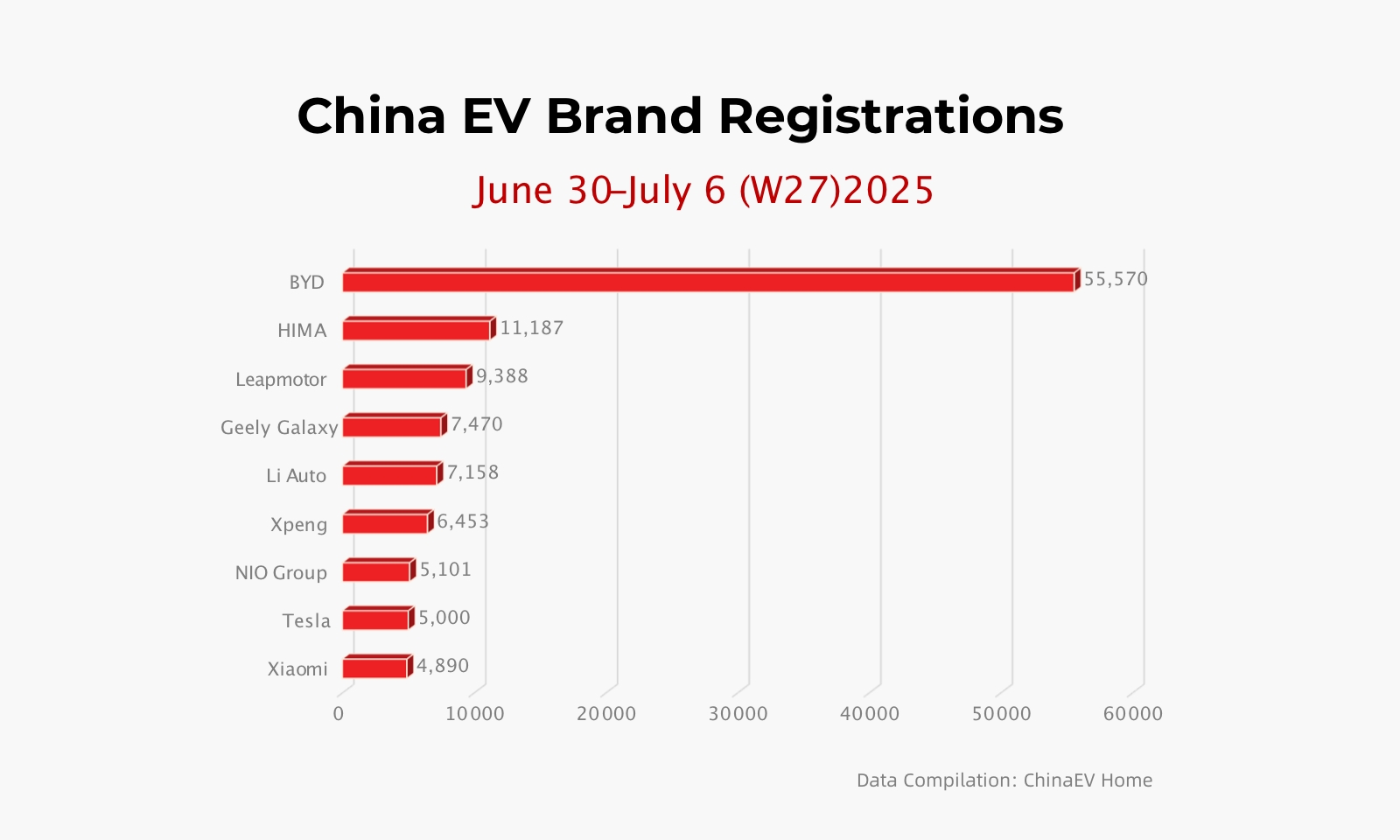
BYD remained the undisputed leader with 55,570 units sold, despite a sharp 29.3% drop from 78,570 units in Week 26. The brand’s stronghold remains unshaken, supported by its ongoing global expansion efforts. AITO secured second place with 9,400 units, down 19.8%. According to auto blogger @万万_ECC, the Harmony Intelligent Mobility Alliance (HIMA) delivered 11,187 units, with AITO accounting for nearly 84% of those.
Leapmotor ranked third with 9,390 units, a 11.6% dip from last week’s 10,620 units. Geely’s Galaxy brand followed with 7,470 units, marking a 29.5% decline but a slight improvement in its overall ranking. Li Auto and XPeng rounded out the top six with 7,160 and 6,450 units, respectively. Li Auto sales dropped 10.1%, while XPeng saw a steeper decline of 42.4%.
According to data shared by @万万_ECC, NIO recorded a total of 5,101 units sold this week. The breakdown includes 2,496 NIO-branded units, 1,309 units from the Onvo brand, and 1,296 units from the Firefly. Firefly has experienced a rise in sales volume since launching its Battery-as-a-Service (BaaS) program in late June. Anticipation is building for the upcoming launch of the Onvo L90 and the third-generation NIO ES8, as well as the rescheduled NIODay now set for Q3—all of which may fuel stronger Q3 performance.

Tesla, notably, experienced a sharp 75.8% week-over-week plunge, selling only 5,010 units, a dramatic fall from second to seventh place. The slump may be attributed to intensified competition as several new models hit the market in the same period. In addition, Xiaomi Auto followed closely with 4,890 units, down 46.2% week-over-week. Analysts believe the dip was due to YU7 production constraints and heightened market competition following the launch of rival models.
Other emerging NEV brands—including Deepal, Formula Leopard, Zeekr, and Voyah—reported relatively stable weekly performance, though most experienced mild declines.
Simply put, with the end-of-June sales push concluded and the market bracing for multiple new launches in Q3, Week 27 marked a transitional phase for the NEV sector. Despite a general dip in sales, market leadership remained largely unchanged. Whether the upcoming wave of vehicle deliveries will reshuffle the rankings remains to be seen.
Discover more from ChinaEVHome
Subscribe to get the latest posts sent to your email.