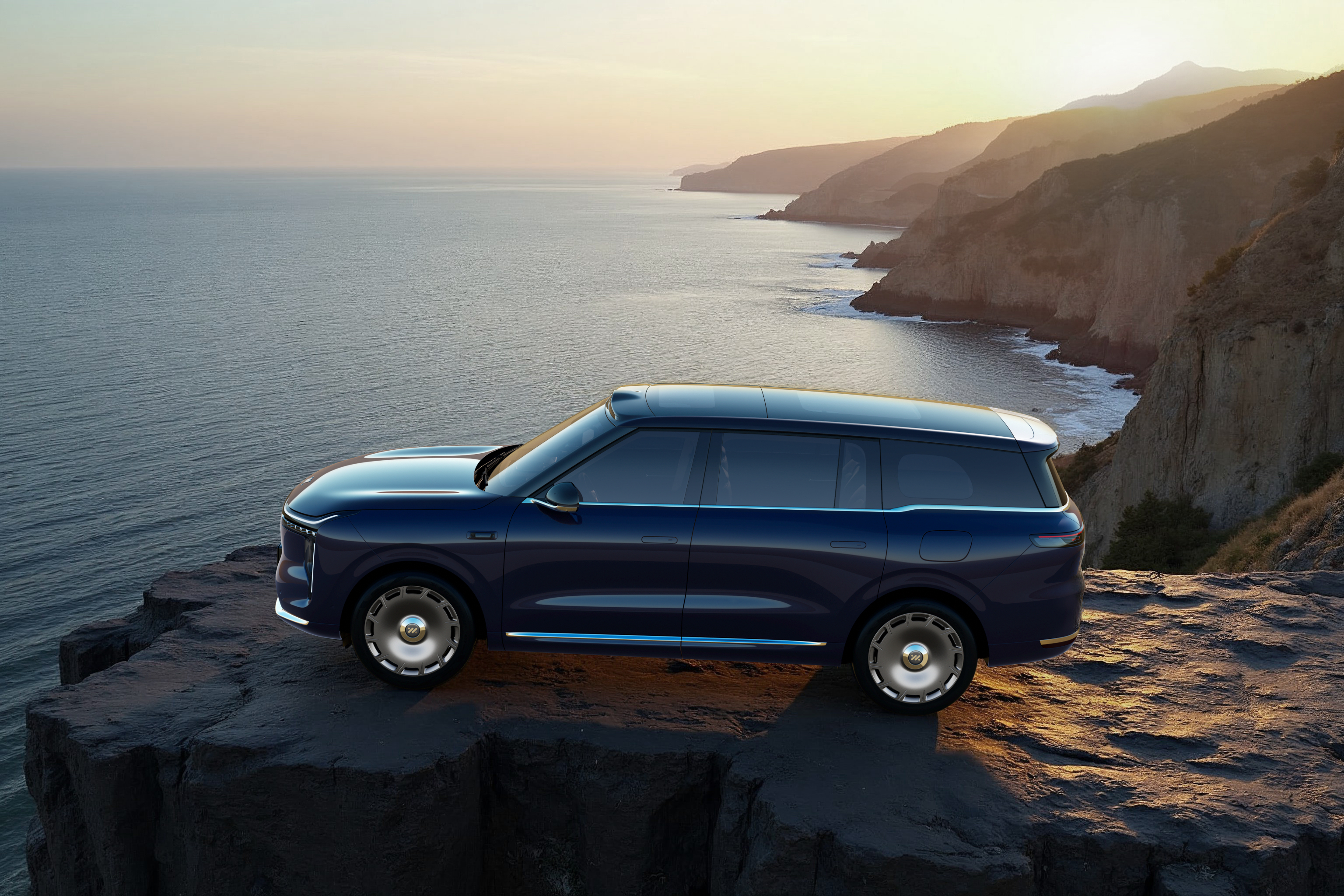
IM Motors introduces “Stellar” super range extender with 450km EV range, 1500km total range, aiming to redefine NEV power systems.
On August 1, the increasingly popular race of “range extender” powertrains welcomed a major new player—IM Motors, with its launch of the “Stellar” super range extender system.
The keyword is “super range extender.”

Entering 2025, powertrain systems branded as “super” have become increasingly common, with “super range extender” leading the charge. Several automakers have already declared their plans to release their own versions within the year, along with a new wave of vehicles.
As of now, the already released or announced “super range extender” systems share several similarities: dedicated range extender battery packs, 800V architecture, all-electric range typically exceeding 200km, with some reaching beyond 300km.
However, as reported by ChinaEVHome earlier this week, these super range extender models have not yet achieved anticipated sales success. Some users told ChinaEVHome that a 300km pure electric range hasn’t fundamentally improved the experience of range extender vehicles.
What users expect from a “super range extender” is a system offering over 400km pure electric range—comparable to conventional EVs—while still providing combustion engine backup to eliminate range anxiety.
The question is: can IM Motors’ “Stellar” super range extender fulfill this “perfect solution”?
The Birth of “Stellar”
Let’s begin with the core specs.
IM’s “Stellar” super range extender system features a 66kWh industry-leading battery dedicated to range extension, boosting pure electric range to over 450km, and a combined range exceeding 1500km.

This power battery was co-developed by IM Motors and CATL and is officially named the “Super Xiaoyao MAX” battery—part of CATL’s “Xiaoyao” battery line specifically for range extender systems.
Beyond its record 66kWh capacity, it supports an 800V high-voltage fast charging platform, with a 4C charging rate and a maximum charging power of 268kW. In just 15 minutes, it can recharge up to 310km of range.

IM Motors claims this charging performance rivals mainstream EVs, branding the experience as akin to “an EV with its own supercharger,” setting it apart from traditional range extenders that rely more heavily on home chargers.
In addition to range specs, IM emphasizes the system’s powerful performance even under low battery conditions. The “Super Xiaoyao MAX” battery maintains 275.5kW output even at low charge.
Combined with the 800V silicon carbide “Hurricane” electric motor (range extender edition), vehicles using this system can maintain strong acceleration (e.g., from 80 to 120 km/h) even when the battery is depleted—avoiding the typical issue where range extender vehicles perform excellently on full charge but poorly when low.
Another crucial component is the range extender engine. IM has custom-developed the “Zephyr” ultra-efficient gold-standard engine, featuring next-gen VGT variable turbo and wide-range exhaust gas recirculation to keep the engine operating in its thermal efficiency “golden zone” under all conditions.

On regular 92-octane gasoline, the IM Stellar-equipped vehicle achieves a fuel consumption of just 5.32L/100km, claiming the lowest in its class. Its hybrid fuel-electricity consumption stands at 2.07L/100km, also a best-in-class figure for mid-to-large SUVs.

NVH (noise, vibration, harshness) has also been a common pain point for range extender vehicles, especially when the generator kicks in during low battery scenarios. To address this, IM Motors has taken a two-pronged approach: optimizing generator noise and vibration, and introducing the industry’s first ERNC active noise cancellation system.

Data shows that Stellar-equipped test vehicles achieve an interior idle noise level below 36dB. When the range extender activates, noise increases by no more than 0.34dB, sometimes as little as 0.01dB—making the engine’s operation virtually undetectable for passengers. Over a 1500km journey, the experience mimics that of a pure electric drive.
In terms of safety and practicality, the “Super Xiaoyao MAX” battery is said to meet aerospace-grade safety standards, with a defect rate of just one in a billion. Its large capacity reduces charge cycles, prolonging lifespan, and IM has emphasized that battery longevity was a focus during R&D. Seven layers of protection further enhance system safety.

To address concerns from northern users, IM has developed winter optimization strategies. When temperatures drop below -10°C, a rapid heating mode activates, reducing engine warm-up time. The battery can deliver up to 170kW charging power even in low temperatures, alleviating concerns about winter NEV usability.

IM Motors positions Stellar and its future vehicle applications as a “new category” of NEV.
The questions naturally follow: how exactly does the “Stellar” super range extender differ from traditional range extender systems? And is it an exaggeration to call it a “new category” of NEV?
Why Is the “Stellar” Regarded as a New Category of NEV?
This claim is not unfounded. Today’s three mainstream powertrains—BEV (battery electric vehicle), PHEV (plug-in hybrid), and EREV (extended-range electric vehicle)—each come with their own user experience drawbacks.
According to IM, the overall NEV penetration rate has passed 50%, which still leaves nearly half the market untouched—mostly due to dissatisfaction with these current systems.
This has become the breakthrough point for the birth of IM Motors’ “Stellar” super range extender—by addressing the existing user experience issues and converting the remaining 50% of potential consumers.
BEVs are limited in range by battery size; a typical 100kWh pack in a mid-to-large SUV offers less than 700km CLTC range, causing concern for long trips.
PHEVs and EREVs generally offer only 200–300km electric range. IM’s research found that a 333km pure electric range can meet 92% of users’ weekly commuting needs, while 300km suffices for 92.4% of weekend trips.

To fulfill this, real-world pure electric range for EREVs must be at least 300km. In reality, most max out under 200km, making even weekday commuting require 2–3 charges per week.
With a 450+km pure EV range, the Stellar system solves this issue—allowing users to use electric mode freely without frequent recharging.
Moreover, the Stellar’s recharging capability redefines the category. Despite being an EREV, it features EV-grade specs like 800V architecture and 4C charging, with initial charging power up to 200kW—263% higher than typical EREVs that rarely exceed 2C and rely on home chargers.
Without home charging, EREV owners often suffer from slow charging and frequent stops. Stellar frees them from this constraint.
The core value of this new category lies in “user experience liberation”—eliminating both EV range anxiety and recharging inconvenience.
Considering current mainstream powertrains have compromises, Stellar offers a potentially optimal blend: BEV-grade range, PHEV-like convenience, and unmatched recharging flexibility—justifying the “new NEV category” label.
Fierce Competition
Change is already underway. Other automakers are also planning 400km+ range EREVs to target the remaining 50% of users.
While competition may heat up in late 2025, IM holds a first-mover advantage with its 450km range and superior tech in NVH, recharging, and performance.
Even amid the potential “super range extender showdown” at the end of the year, the “Stellar” super range extender system still stands a strong chance of rising above the competition and becoming an unavoidable reference point in public discussions on the topic.

This could affect the entire NEV ecosystem, particularly mid-range BEVs. In 2024, EREV sales reached 1.167 million units, up 78.7% year-over-year, while BEV growth slowed to 15.5%.
Although BEVs still dominate in volume, this edge was built on limited EREV offerings and shorter BEV ranges. With Stellar’s arrival and more models offering longer ranges, EREVs could start encroaching on mid-range BEV territory.
Given the Stellar system’s specs—450km pure EV range, 800V fast charging, 4C charge rate, and 1500km backup—it will make buyers reconsider choosing 500–600km range BEVs at similar price points.
In the near future, consumers may find themselves choosing between “super range extenders” and “long-range BEVs,” with mid-range BEVs losing market share.
Even conservatively, Stellar expands the range extender category and offers consumers a richer, more flexible choice.
The Stellar launch significantly strengthens IM’s competitive edge. July sales reached 7,027 units. The IM L6 and LS6 ranked Top 2 in the “RMB 200,000+ ($28,000+) mid-to-large EV sedan/SUV” segment.
At the product level, IM announced during the launch that the next-gen LS6, first to feature Stellar, will open for pre-orders on August 15. Its flagship SUV, the LS9, also equipped with Stellar, will debut in Q4 2025.

With “strong sales,” “strong products,” and “strong technology” forming a virtuous loop, we can now wait to see whether IM Motors can sustain its growth, driven by the LS6 and LS9 and the promise of Stellar. The answer will be revealed soon.
Discover more from ChinaEVHome
Subscribe to get the latest posts sent to your email.