The crash test controversy takes a new turn as CAERI admits the tested truck was secondhand. Li Auto rushes to clarify and defuse tensions.
On August 3, both Li Auto and China Automotive Engineering Research Institute (CAERI) issued follow-up statements addressing the ongoing controversy surrounding the “i8 crash test incident.” Key corrections and contradictory details reignited heated debate across the industry and online platforms.
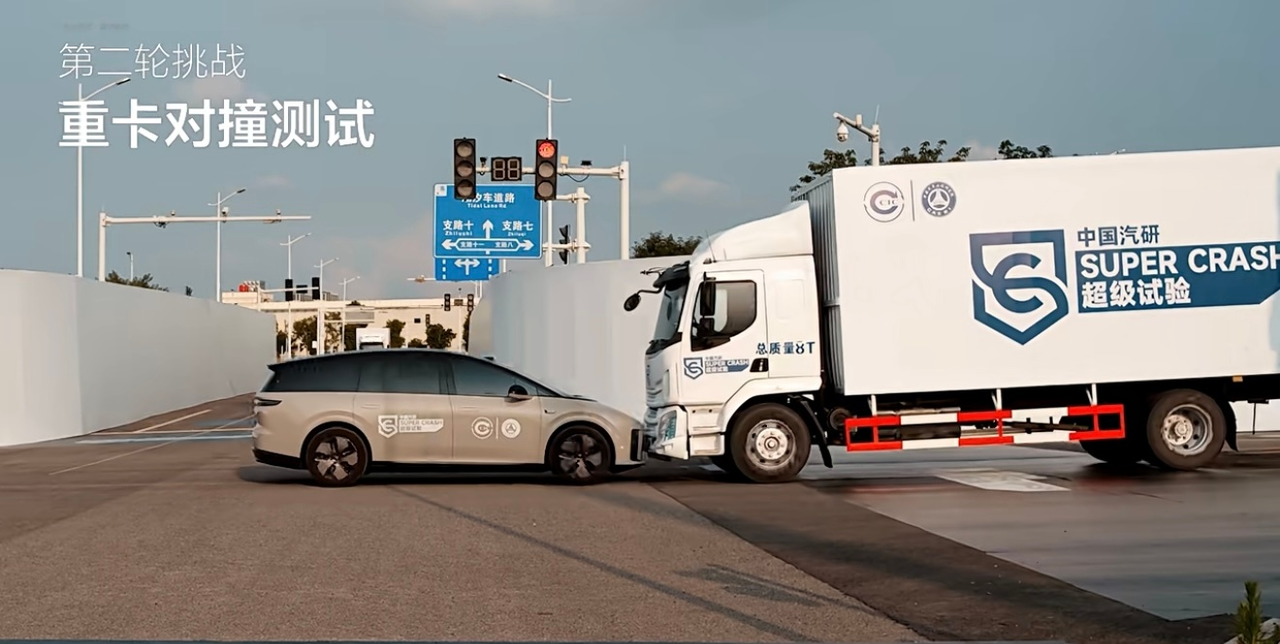
The situation stems from a crash test video shown at the Li Auto i8 launch event on July 29. The footage depicted an 8-ton heavy-duty truck labeled as a Chenglong model colliding head-on with the i8 at a relative speed of 100 km/h. The truck was shown being lifted off the ground, with its cabin crumpling and disintegrating, while the i8 remained structurally intact. The dramatic visual triggered widespread concern over the safety of Chenglong trucks, prompting Dongfeng Liuzhou Motor to issue a legal statement accusing Li Auto of “misleading the public” and potentially violating the law.
This led to a three-way standoff between Dongfeng Liuzhou Motor, Li Auto, and the third-party testing agency CAERI, with each party presenting conflicting narratives—an industry-level game of “he said, she said.”

On August 3, the incident took a critical turn as CAERI released a revised statement addressing three key points:
- Truck Source: CAERI admitted for the first time that the truck used in the test was a secondhand vehicle “randomly purchased from the market,” overturning earlier claims that it was new. The truck was disguised, repainted, and weighted to 8 tons for the test.
- Speed Details: The statement clarified that the i8’s actual speed was 60±2 km/h and the truck’s was 40±2 km/h, summing to a 100 km/h relative impact speed.
- Nature of the Test: CAERI emphasized that the test was solely for “the safety performance of i8,” not part of any vehicle-to-vehicle safety standards, and “absolutely not intended to evaluate the safety performance of other brands.”

Shortly afterward, Li Auto issued an urgent clarification titled “Explanation Regarding Li Auto i8 Safety Crash Test.” In it, the company characterized the use of the Chenglong truck as “entirely unintentional,” describing the truck merely as a “moving obstacle” in the test. Li Auto also praised Dongfeng Liuzhou Motor as a “benchmark in China’s truck industry,” seemingly in an effort to downplay any perception of brand rivalry. The statement stressed that the test had been outsourced to a third-party agency, and that Li Auto “did not specify the truck brand.” It also reaffirmed that the i8 has passed multiple authoritative certifications, including a five-star C-NCAP safety rating.

These clarifications brought a partial reversal to the narrative. Although both parties are trying to cool public reaction, many netizens remain skeptical about the technical validity of the test.
Some truck industry professionals have pointed out that for a truck cabin to separate as shown, three mechanical lock mechanisms would need to disengage simultaneously—a scenario considered extremely unlikely in real-world conditions. Furthermore, an 8-ton unladen truck configuration significantly differs from real logistics trucks, which typically carry over 30 tons.
Calculations show that the i8’s actual kinetic energy (493 kJ) far exceeded that of the truck (278 kJ). While the lever effect may have amplified the visual impact, Li Auto has not disclosed key parameters such as the truck’s cabin locking mechanism status.
Currently, Dongfeng Liuzhou Motor has cited the Anti-Unfair Competition Law and initiated legal proceedings, stating that the viral crash test video has raised safety concerns among major clients such as SF Express and JD.com, directly threatening the core reputation of its commercial vehicle division.

Despite the second round of statements, this crash test saga is far from over. Some netizens have noted that the video playing in Li Auto showrooms now has the truck logo blurred out. Meanwhile, in Chenglong’s livestream, presenters have held up posters reading “Only the Living Have the Right to Talk About Ideals,” an open jab at Li Auto.
Discover more from ChinaEVHome
Subscribe to get the latest posts sent to your email.