Under the circumstances of Geely Auto’s continuous revenue growth and Zeekr Technology’s narrowing losses, where will Geely’s next breakthrough for growth be?
Geely Auto’s momentum remains strong.
In the first half of 2025, Geely Auto once again set a new performance record.
During this six-month period, Geely Auto:
- Revenue exceeded RMB 150 billion($21 billion)for the first time, reaching RMB 150.282 billion($21 billion), compared to RMB 118.793 billion ($16.6 billion) in the same period last year, a year-on-year increase of 27%;
- Net profit attributable to shareholders was RMB 9.29 billion($1.3 billion), a year-on-year decrease of 14%;
- Core net profit attributable to shareholders was RMB 6.66 billion($930 million), a year-on-year increase of 102%;
- Gross margin slightly declined by 0.3 percentage points to 16.4%;
- Total cash reserves stood at RMB 58.8 billion ($8.2 billion), compared to RMB 46.6 billion ($6.5 billion) in the same period last year;
- R&D expenditure was RMB 7.328 billion($1.03 billion), a year-on-year increase of 27%.

Meanwhile, Zeekr Technology Group, which recently returned to Geely Auto, also released its half-year report. The company, which carries Geely’s hopes for the new energy era, is still operating at a loss.
Zeekr Technology’s performance in the first half of 2025:
- Revenue was RMB 49.45 billion, nearly unchanged from RMB 49.452 billion ($6.9 billion)in the same period last year;
- Net loss was RMB 1.05 billion ($147 million), compared to RMB 4.484 billion (USD 628 million)in the same period last year, a year-on-year decrease of 76.58%;
- Comprehensive gross margin was 20%, with vehicle gross margin at 16.9%;
- Cash and cash equivalents totaled RMB 10.21 billion ($1.43 billion);
- R&D expenditure was RMB 5.054 billion($708 million), a year-on-year decrease of 16.96%.

As Geely Auto’s revenue continues to grow and Zeekr Technology’s losses shrink, where will Geely’s next growth breakthrough come from?
Following BYD’s Lead
In its mid-term performance infographic, Geely mentioned a concept not included in the official financial report: core net profit attributable to shareholders.
According to Geely, this figure excludes one-time factors such as post-tax net gains from foreign exchange, impairment losses on non-financial assets, and gains from deemed disposals of subsidiaries and impairment losses on assets classified as held for sale in 2024. This adjustment provides a more accurate reflection of the company’s performance in the first half of the year.
Thus, considering the RMB 7.726 billion ($1.08 billion) in “deemed disposal gains of subsidiaries and asset impairment losses” in 2024 and the impact of foreign exchange gains in 2025, Geely’s core net profit attributable to shareholders grew by 102% to RMB 6.66 billion ($930 million).

For Geely, the more encouraging news is that it sold 1.409 million new vehicles in the first half of the year (a 47% YoY increase), including 725,000 new energy vehicles (a 126% YoY increase). New energy vehicles now account for 51% of total sales, surpassing internal combustion engine vehicles.
The credit for Geely’s rising new energy vehicle sales and share goes to Galaxy.
In the first half of this year, Galaxy sold 548,000 new vehicles. In the same period last year, Galaxy’s total sales were only 81,000 units. This brand, less than two and a half years old, achieved cumulative sales of 1.2 million units by late July this year, demonstrating astonishing growth.
As Galaxy rises, the competition between Geely and BYD has intensified.
Galaxy’s product lineup is precisely targeting BYD’s market.
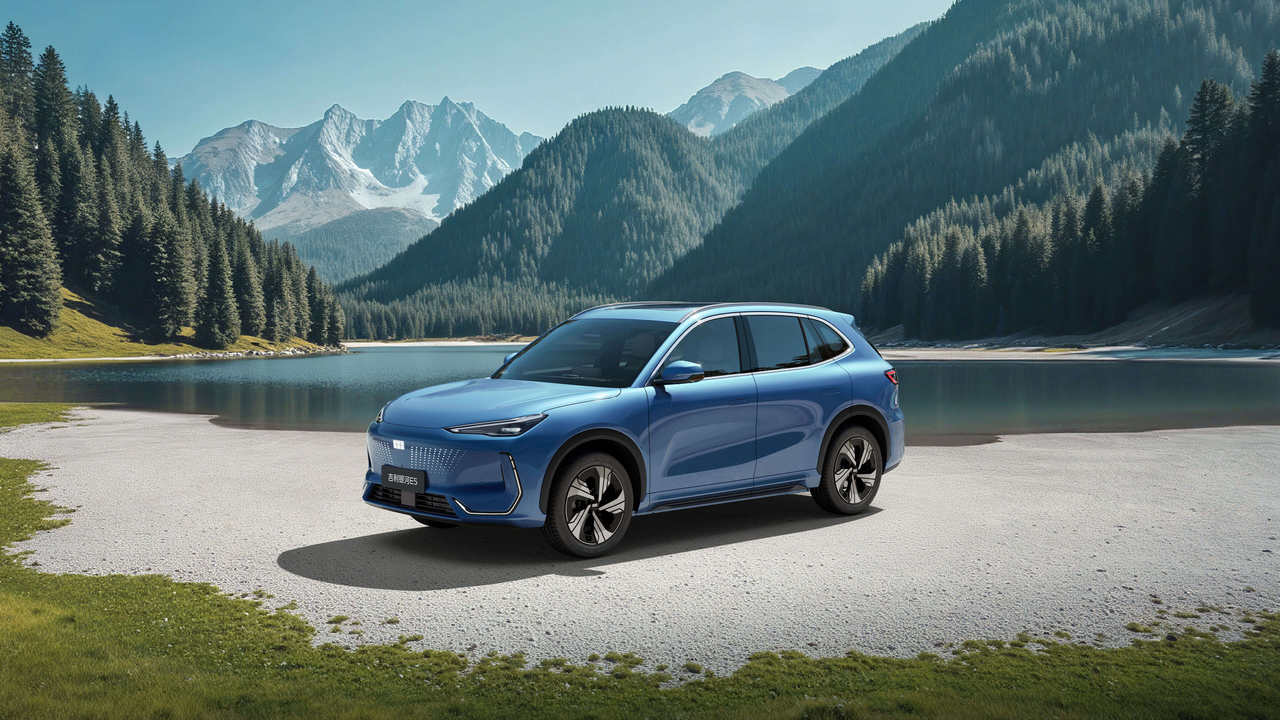
For example, the Galaxy E5 competes with the BYD Yuan, the Galaxy StarShip 7 EM-i with the BYD Song, and the Geely Xingyuan with the BYD Seagull. Additionally, Geely’s EM-i and EM-P compete with BYD’s DM-i, while Flyme Auto rivals DiLink. From technology to products, Geely is benchmarking itself against BYD.

As a latecomer, Galaxy aims to address the pain points of BYD’s products, striving to outperform BYD in one or more aspects.
By closely competing with BYD, Galaxy has helped Geely Auto become the top-selling Chinese domestic brand for internal combustion engine vehicles and the second-largest for new energy vehicles in just two and a half years.
This directly contributed to Geely’s revenue of RMB 150.282 billion ($21 billion), a 27% year-on-year increase, with RMB 134.599 billion ($18.8 billion) coming from vehicle sales and related services, up 28.43%.
However, despite Geely Auto’s continuous breakthroughs, there remains a gap compared to BYD. BYD’s revenue in the first quarter alone reached RMB 170.36 billion ($23.8 billion), a 36.4% YoY increase, while net profit rose 100.4% to RMB 9.155 billion ($1.28 billion).
More importantly, excluding its battery business, BYD’s automotive gross margin was 23.9%. In contrast, Geely Auto did not disclose its automotive gross margin for the first half of the year, with its overall gross margin at 16.4%.

Like BYD’s struggles with brands such as Denza and Yangwang, Geely, despite its “value war” approach, still faces challenges with declining average selling prices.
In the first half of 2025, Geely Auto’s average selling price per vehicle was around RMB 95,400 ($13,100), compared with RMB 109,700 ($15,000) in the same period of 2024—a YoY drop of RMB 14,000 ($1,900).
While the positioning of internal combustion engine vehicles plays a role, as new energy vehicles gain prominence in overall sales, they must shoulder greater profit responsibilities. For most automakers, mid-to-high-end brands consistently deliver stronger profit performance.
Thus, Zeekr Technology Group, aiming for “upward and broader” growth, is digging deeper in its respective directions.
Expanding Upmarket and Broadening Reach
Lynk & Co and Zeekr’s performance in the first half of the year had both highlights and areas for long-term improvement.
In the first half of 2025, Lynk & Co delivered 154,000 new vehicles, a 22.2% year-on-year increase, while Zeekr delivered 90,700 units, up 3.2%. The two brands generated sales revenue of RMB 21.1 billion ($2.95 billion) and RMB 20.912 billion ($2.93 billion), respectively, during this period.
Lynk & Co became the primary growth driver for Zeekr Technology in terms of both sales and revenue in the first half of the year.
Lynk & Co’s full-scale push into the new energy market in the second half of 2024 has provided new upward opportunities.
The launch of the Lynk & Co 900, starting at RMB 309,900 ($43,400), has shown a clear upward trend in monthly sales, rising from 5,593 units in May to 6,680 units in July after full-scale deliveries began in June.

However, as the volume driver within Zeekr Technology Group, Lynk & Co’s sales growth has yet to peak. The Lynk & Co Z10 and Z20, launched in the second half of last year, have underperformed, with the Z10 selling fewer than 500 units per month and the Z20 dropping from over 6,000 units to just over 2,000 units per month.
As a result, the Lynk & Co 10 EM-P, considered the plug-in hybrid version of the Z10, is set to launch in September to strengthen Lynk & Co’s new energy sedan lineup.
Zeekr, which showed slightly sluggish growth in the first half of the year, has also announced product iteration plans starting in September.
The 2026 Zeekr 001 and Zeekr 7X, already listed with the Ministry of Industry and Information Technology, feature more powerful performance. Updates such as the Thor-U chip and Qilin battery signal Zeekr’s determination to move upward.
Before this, Zeekr must successfully launch the Zeekr 9X.

Not only is it Zeekr’s highest-positioned SUV to date, but it will also be the first model equipped with Zeekr’s ultra-hybrid technology. The success of this model’s launch will impact Zeekr’s brand image and the rollout of other models under this technology.
For companies targeting the mid-to-high-end market, what constitutes good or acceptable profit performance? Tesla may serve as a reference for new energy vehicle brands.
Despite declines in both revenue and profit in the first half of this year, Tesla still posted a net profit of $2.327 billion on revenue of $41.8 billion, down 30% year-on-year, with an automotive gross margin of 17.2%.
With a vehicle gross margin of 16.9%, Zeekr Technology is already close to Tesla’s level. However, there remains a significant gap in volume. Even without comparing to Tesla, volume is the foundation of profitability, and Zeekr Technology’s volume goals are far from complete.
Beyond their impressive achievements, the brands under Geely Auto each have areas for further progress. As we approach the critical point of Geely’s new vehicle launches in the third quarter, what moves can we expect from Geely?
(The End)
Discover more from ChinaEVHome
Subscribe to get the latest posts sent to your email.