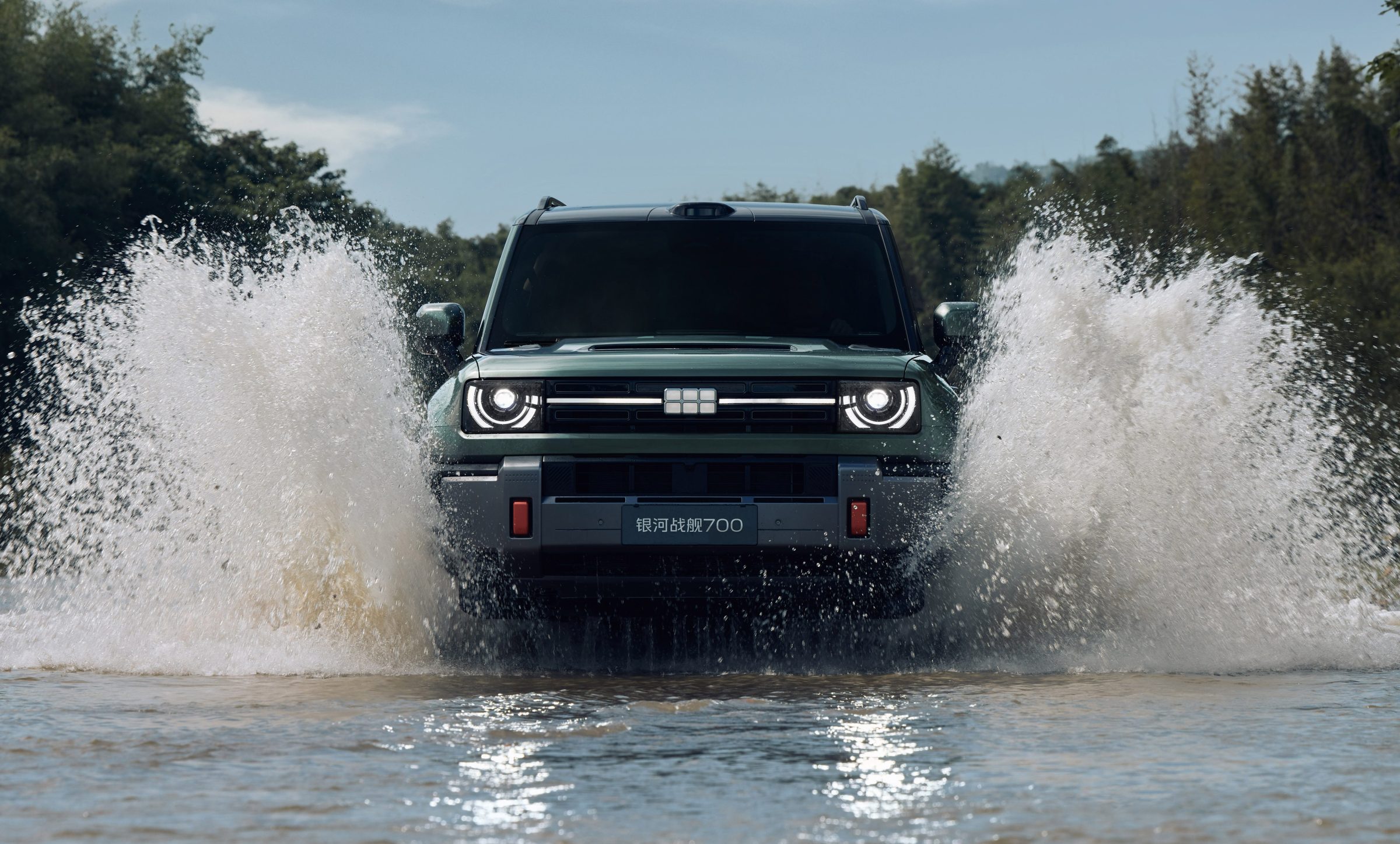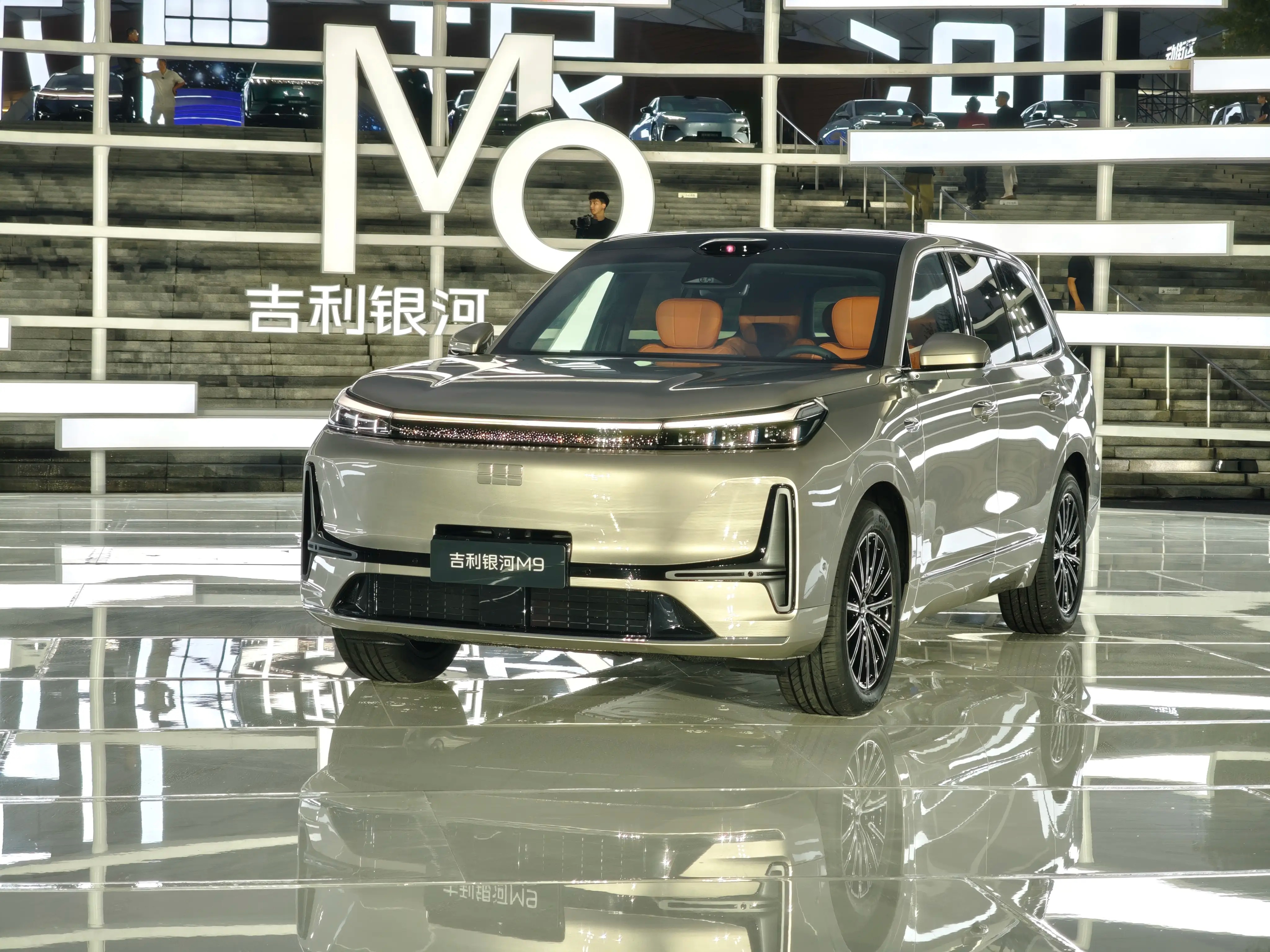
With the official launch of the Geely Galaxy M9, the large three-row SUV segment has gained another strong contender.
On August 23rd, the global pre-sale of the Geely Galaxy M9 officially kicked off. Prior to this, the official had already announced its “achievement”: orders exceeded 40,000 units within 24 hours, setting a new pre-sale record for the Geely Galaxy brand.
On September 17th, the 28th day after the launch of the global pre-sale, the Geely Galaxy M9 was officially launched.

The pre-sale price ranged from RMB 193,800 (approximately $27,219) to RMB 258,800 (approximately $36,348), while the official launch price is RMB 173,800 (approximately $24,410) to RMB 238,800 (approximately $33,539) (including a limited-time RMB 10,000 (approximately $1,405) subsidy). The Geely Galaxy M9 offers a total of 6 SKUs, with the top configuration equipped with a distributed three-motor four-wheel drive system, making it another strong competitor in the large three-row SUV segment.
In addition, the official stated that the Star Ocean Ripple front through-type lights, the 27-speaker Flyme Sound Boundless Audio System valued at RMB 15,800 (approximately $2,220), a RMB 7,000 (approximately $983) voucher for optional electric side steps, and a RMB 7,000 (approximately $983) “Magic Carpet Star Cruise Package” for the four-wheel drive version will continue to be offered as gifts.
Geely Galaxy’s pricing strategy may, on the one hand, aim to create a more distinct positioning difference from other large SUVs within the group, such as the Lynk & Co 900. On the other hand, it can further enhance its competitive advantages in the large three-row new energy SUV market to cope with potential direct competitors in the future.
Next, let’s take a quick review of the content from tonight’s launch event.
Geely-Style Intelligence
Before discussing the hardware configuration of the Galaxy M9, let’s first take a look at Geely’s most aggressive move this year – AI.
On the evening of August 20th, Geely officially announced its “One Cockpit” strategy, launching what it claims to be the industry’s first AI cockpit, and announced the termination of the development of “traditional non-AI cockpits”.
The Geely Galaxy M9 makes its debut with Flyme Auto 2, a phased achievement under the “One Cockpit” strategy.

Its visual effects have been fully upgraded, featuring large desktop cards, a new small window mode, live desktop, and Alive wallpapers. It also integrates the Amap 850 version with precise navigation, multi-screen interactive streaming, AI image enhancement, and other functions.
The new vehicle is also equipped with Eva, the world’s first large-scale on-board anthropomorphic emotional intelligent agent, which can independently judge, plan, and execute tasks.

The M9 also adopts industry-leading end-to-end voice technology, supporting more than 20 human-like voice interaction functions, including emotion recognition, “voice proxy” for outside the vehicle, and object recognition outside the vehicle. Users only need to express their feelings, and Eva can understand and execute the corresponding commands.
It also features the industry’s first “Flowing Memory” function, which, like a personal butler, remembers the user’s preferences and needs, and becomes “smarter” with use through deep learning.
The Galaxy M9 is equipped with all the hardware that a flagship cockpit should have: the Qualcomm 8295P flagship chip, a 30-inch 6K integrated Sky Screen, a 32-inch AR-HUD, and a 17.3-inch rear-row entertainment screen.
At the same time, it is equipped with a 27-speaker Flyme Sound Boundless Audio System, which claims to have the largest number of speakers in its class, with a power of 2300W and a 9.1.6 channel layout.
After discussing the intelligent cockpit, let’s move on to the more core aspects of the Galaxy M9 – the chassis and space.
Space and Driving Control: Also “Geely-Characteristic”
In the past, traditional six-seat SUVs have always had two pain points: poor riding experience in the third row and difficult handling. According to the official statement, the Geely Galaxy M9 is specifically designed to solve these two issues.
The vehicle has a length, width, and height of 5205/1999/1800mm, with a wheelbase of over 3000mm. However, a large vehicle should not be “bulky outside but cramped inside”. It offers an interior area of 5.2㎡ and a space utilization rate (comparable to “floor area ratio” for vehicles) of 88.3%, claiming to be the best in its class.
The second row features a “zero-threshold” design, with a maximum door opening height of 1.1m and a low threshold of 470mm; the third row has a width of 1070mm, a legroom of 900mm, and the seats can recline up to 150 degrees.

The floor of the first, second, and third rows is completely flat. The aisle width is 180mm, and the corridor width is 1.3m, claiming to be the widest in its class.
In the full passenger load state, the trunk volume is 328L, with a class-leading maximum depth of 590mm, allowing each person to have a suitcase. When the third row is folded down, the volume can reach 1025L; when all three rows are folded down with one click, the volume can be expanded to 2171L.
It supports 8 seat combination scenarios with one-click adjustment and 96 custom combinations, making full use of the Galaxy M9’s space advantages.
In addition, the two-wheel drive version can provide additional underfloor storage space, all thanks to the benefits brought by the GEA EVO architecture.
When it comes to driving and riding configurations, the Geely Galaxy M9 is equipped with a front double-wishbone + rear five-link suspension, and what it claims to be the only dual-chamber closed air spring in its class. It is also paired with a CCD continuously variable damping shock absorber, supporting four-wheel independent one-click leveling. The system’s maximum comprehensive power and maximum comprehensive torque are 640kW and 1165N·m respectively.

While delivering powerful performance, the Geely Galaxy M9 also achieves excellent energy efficiency. Its CLTC fuel consumption under battery-depleted condition is 4.8L/100km, the engine thermal efficiency reaches 47.26%, and the dual-motor drive efficiency is 89.5%, all claiming to be the highest in the industry.
Among them, the three-motor four-wheel drive version can achieve a “Waltz U-turn”, with a minimum turning radius of 3.45m.
It is equipped with the industry-leading GVMC Vehicle Dynamic Control System, which realizes the integrated control of XYZ three axes, supports full-scenario tire blowout safety control, and has been tuned by Lotus’ top team with real-vehicle testing at the Nürburgring track.
In terms of range, the Geely Galaxy M9 has a maximum pure electric range of 230km and a maximum comprehensive range of 1505km. Compared with other large extended-range SUVs of the same level, such as the Li Auto L8 and AITO M8 extended-range versions, its pure electric range data is not outstanding.
However, considering that the Thor EM-P AI hybrid system supports direct engine drive, it has an advantage in terms of working condition flexibility.
Versions above the 100km two-wheel drive Intelligent Navigation Edition are equipped as standard with the Qianli Haohan (Thousand-Mile Vast) Advanced Driver Assistance System H5 solution, which includes 11 high-definition cameras, 3 millimeter-wave radars, 1 lidar, and 12 ultrasonic radars.
Whether in terms of the cockpit or the chassis, the Geely Galaxy M9’s sincerity is reflected in its configuration list. From the enthusiastic applause at the launch event, it can be seen that the new vehicle’s product strength is sufficient to arouse the “adrenaline” of many people.
Is It Worth Buying?
In recent years, the Geely Galaxy brand has achieved remarkable results. Gan Jiayue stated that the cumulative sales volume of the Geely Galaxy brand has exceeded 1,330,000 units, making it the new energy brand that has reached the million-sales milestone the fastest.
Models such as the Geely Galaxy A7, E5, Xingyuan (Star Wish), and Xingjian (Star Ship) 7 have continued to lead in their respective market segments, showing strong momentum.
Now, with the launch of the Geely Galaxy M9, it is also a “blockbuster” in the large six-seat SUV segment, and it is precisely positioned in the mainstream consumer price range. It may become another sales pillar of the brand.
Compared with these visible and tangible explicit configurations, large six-seat SUVs need to address consumers’ inherent perception that “large cars are difficult to drive”, and this will take time.
Can the Geely Galaxy M9 take on this important responsibility?
Discover more from ChinaEVHome
Subscribe to get the latest posts sent to your email.