Whether the Li Auto i6 can ultimately succeed in pulling Li Auto’s sales figures back up as intended remains to be seen.
The Li Auto i6 was officially launched on September 26, continuing the pricing strategy from the Li Auto ONE era by offering only a single configuration priced at 249,800 yuan

During the initial sales period, customers who place an order can enjoy a 10,000 yuan cash discount and receive three optional features as complimentary additions: the dual-chamber air suspension, a compressor-powered cooling and heating fridge, and quiet power-suction doors.
In other words, early buyers pay only RMB 239,800 for the vehicle, the three extras, 720 km of CLTC range, the right-rear “Queen Seat,” CDC sport dampers and the full AD Max assisted-driving stack.
Interestingly, although the i6 is the volume play in Li Auto’s pure-electric line-up, its launch event and marketing barely mentioned “family use.” Instead, the talk was all about sportiness, handling and youth appeal—a clear bid for a younger audience.
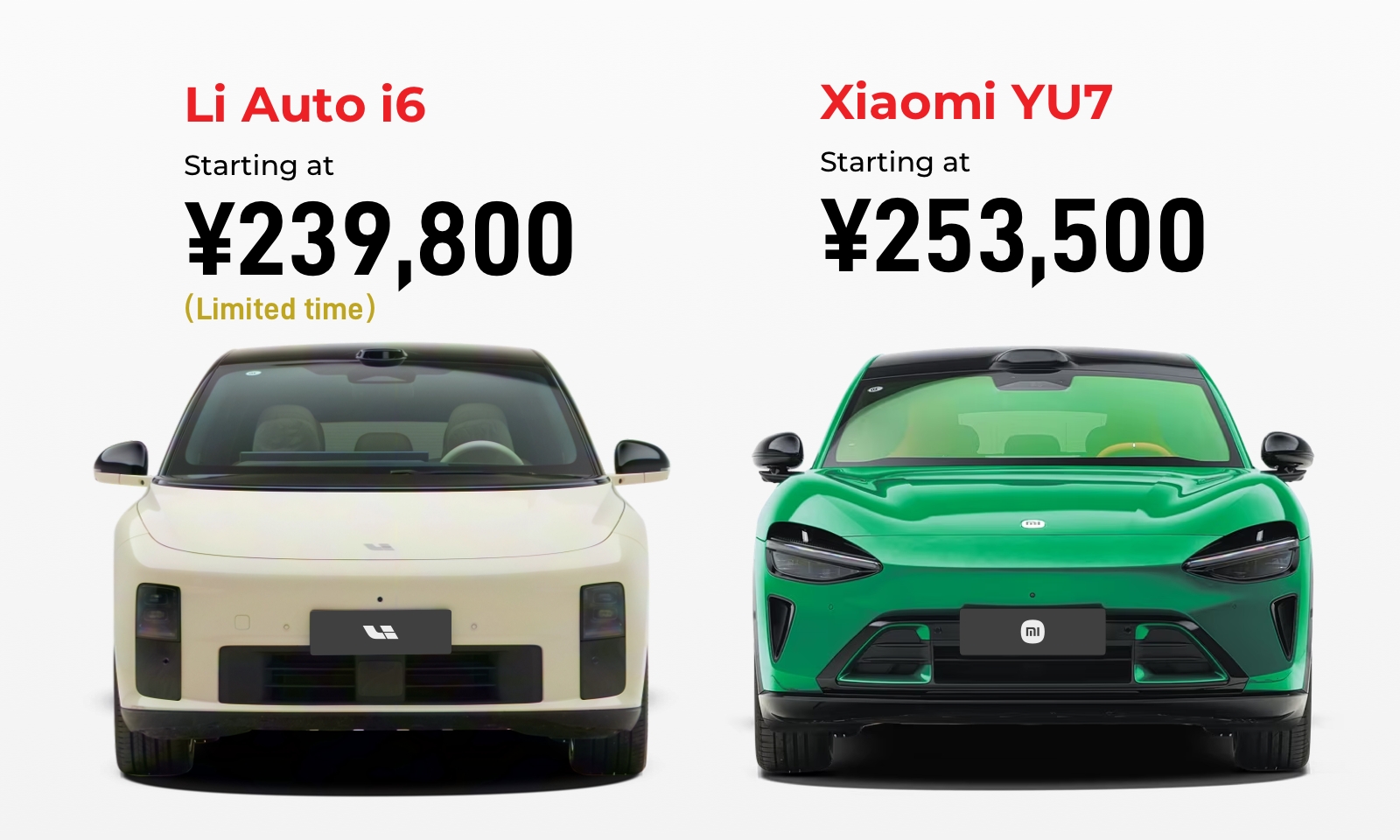
Still, the 250,000-yuan pure-electric-SUV segment is crowded. One formidable rival is the equally youthful and individualistic Xiaomi YU7, whose styling and spec sheet are equally aggressive.
Below, we put the two cars side by side to see which one wins you over.

The Li Auto i6 features a monocoque ‘shark’ design. Its minimalist body, combined with a hatchback-style tailgate, contributes to excellent aerodynamic performance.
With dimensions of 4950×1935×1655mm and a 3000mm wheelbase, the Li Auto i6 maximizes cabin practicality. Its short front and rear overhangs help achieve an impressive 3.3 meters of longitudinal interior space. For storage, it offers a 728L trunk and a front trunk (frunk) capable of holding a 20-inch suitcase.
In contrast, the Xiaomi YU7’s design emphasizes a more sporty attribute. Comparing their dimensions, the Xiaomi YU7 measures 4999x1996x1608/1600mm, with an identical 3000mm wheelbase. The YU7 is slightly longer and wider than the i6, which may translate to marginally more headroom and lateral space.

For the powertrain, the Li Auto i6 defaults to a rear-wheel-drive (RWD) version with a peak motor power of 250kW. An optional all-wheel-drive (AWD) version with a peak power of 400kW and maximum torque of 425N·m / 660N·m is available.
The Xiaomi YU7’s RWD version has a total motor power of 235kW. Its AWD version is more powerful, with a high-performance AWD variant offering a comprehensive power of 508kW and a 0-100 km/h acceleration time of 3.23 seconds. On paper, the Xiaomi YU7 boasts stronger power, especially the high-performance AWD version, promising users a more intense acceleration push.
It is worth mentioning that the Li Auto i6 employs a front double-wishbone + rear five-link suspension. The all-aluminum control arms, commonly found in luxury cars and favored by models like the Mercedes-Benz GLS and Audi Q8, are also featured on the i6. Additionally, the dual-chamber air suspension, offered as a gift during the initial sales period, is another advantage of the i6.

The Li Auto i6 is equipped with an 87.3 kWh battery. A drag coefficient of 0.218 contributes to a 720 km CLTC range and results in energy consumption figures of 13.6 kWh/100km for the RWD version and 14.8 kWh/100km for the AWD version.
Furthermore, the 5C fast-charging capability found in Li Auto’s pure electric models is present in the i6. The automaker states that, supported by 5C technology and an 800V architecture, the i6 can add 500 km of range in just 10 minutes of charging, and it takes 15 minutes to replenish the battery from 10% to 95%.
As a competitor to the Li Auto i6, the entry-level Xiaomi YU7, priced at 253,500 yuan, comes with a 96.3 kWh battery offering a range of 835 km and also supports 800V high-voltage fast charging.

In terms of intelligence, the Li Auto i6 comes standard with a lidar, a 700 TOPS Thor-U ADAS chip, and the AD Max advanced driver-assistance system with permanent free usage.
Additionally, the i6 features a VLA Full-Speed AEB (Automatic Emergency Braking), enabling capabilities such as full-scenario NOA (Navigate on Autopilot), active vehicle feedback and communication for task commands, enhanced memory parking, and AES (Automatic Emergency Steering) with an upper limit of 130 km/h.
The Xiaomi YU7’s intelligent driving-assistance system is also powered by the NVIDIA Thor-U chip with 700 TOPS of computing power. This time, lidar comes standard across the entire YU7 lineup, and its intelligent driving-assistance capabilities will remain consistent across all variants.

For the infotainment system, the Li Auto i6 uses a Qualcomm 8295P chip. Empowered by a large language model, “Voice assistant”has seen its capabilities advance further.
The Xiaomi YU7 is equipped with a Snapdragon 8 Gen 3 chip and HyperOS, potentially holding an advantage in ecosystem connectivity between phones, car systems, and smart home devices.

The Li Auto i6’s front row is equipped with a 16.8-inch Head-Up Display (HUD) and 3K dual screens. The infotainment system uses the Qualcomm Snapdragon 8295P chip and integrates the “Voice assistant” MindGPT large language model, supporting functions like dialogue communication and task execution.
Its interior configuration continues the “movable home” concept, featuring an 8.8-liter cooling and heating fridge, a 21.4-inch 3K rear entertainment screen, a Platinum audio system supporting Dolby 7.3.4 surround sound, and side window sunshades.
The Xiaomi YU7’s interior emphasizes a blend of technology and luxury. The front row uses a 1.1-meter-wide “Sky Screen” that replaces the traditional instrument cluster. Both driver and front passenger seats are equipped with zero-gravity seats. Other comfort features include a 25-speaker audio system, a 4.6-liter fridge, and an EC smart glass roof.

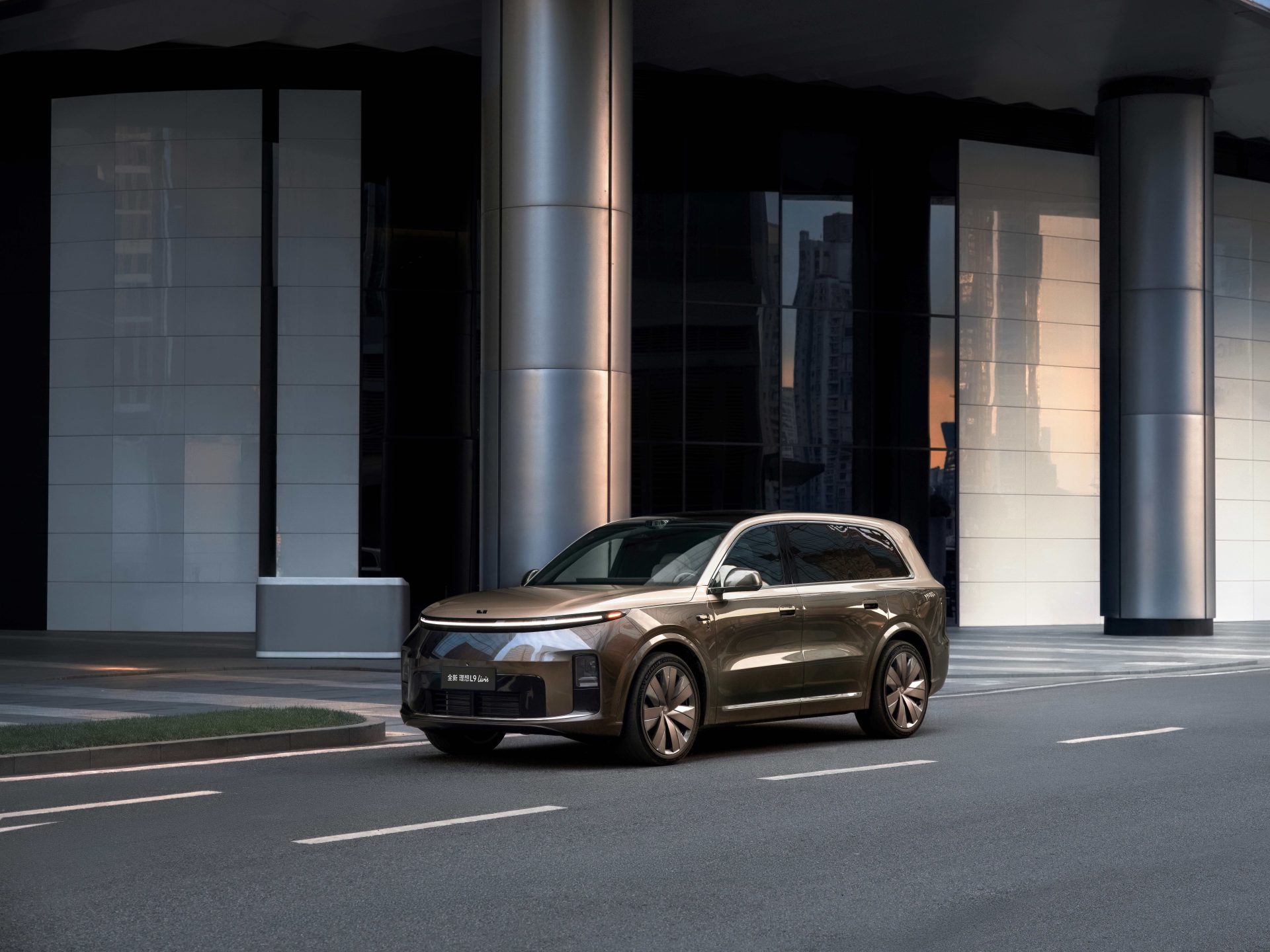
The Li Auto i6 has received a positive market response since its launch. According to an employee from Li Auto’s sales department, “i6 sales have already surpassed the initial launch sales of the L9 model in its time.”
To ensure delivery, the latest production schedule from Li Auto’s Changzhou factory indicates that, including September, the company has prepared a production capacity of approximately 45,000 to 50,000 units for the i6 this year. According to the plan, the i6’s monthly production capacity is expected to ramp up to 25,000 units by December.
The Li Auto i6 marks the beginning of the “upward” movement for Li Auto’s pure electric lineup. However, competition in the 250,000-yuan pure electric SUV segment is exceptionally fierce. The i6 faces competitors not only like the Xiaomi YU7 with its more mature “Human-Car-Home” ecosystem but also models such as the LUXEED R7 bolstered by Huawei’s ADS 4.0 advanced version, and the perennial best-seller Tesla Model Y.
Whether the Li Auto i6 can ultimately succeed in pulling Li Auto’s sales figures back up as intended remains to be seen.
Discover more from ChinaEVHome
Subscribe to get the latest posts sent to your email.