- BYD’s Racco scored over 5,000 confirmed Japan orders in its first week, already outselling BYD’s entire 2025 local passenger sales.
- Racco targets 10,000 cumulative orders by end-2026 while tapping replacement demand—about 70% buyers are existing K‑Car owners.
- Priced from ¥2.145M (¥1.995M after subsidy) with two ranges, Racco aims to disrupt Japan’s domestic-dominated K‑Car segment.
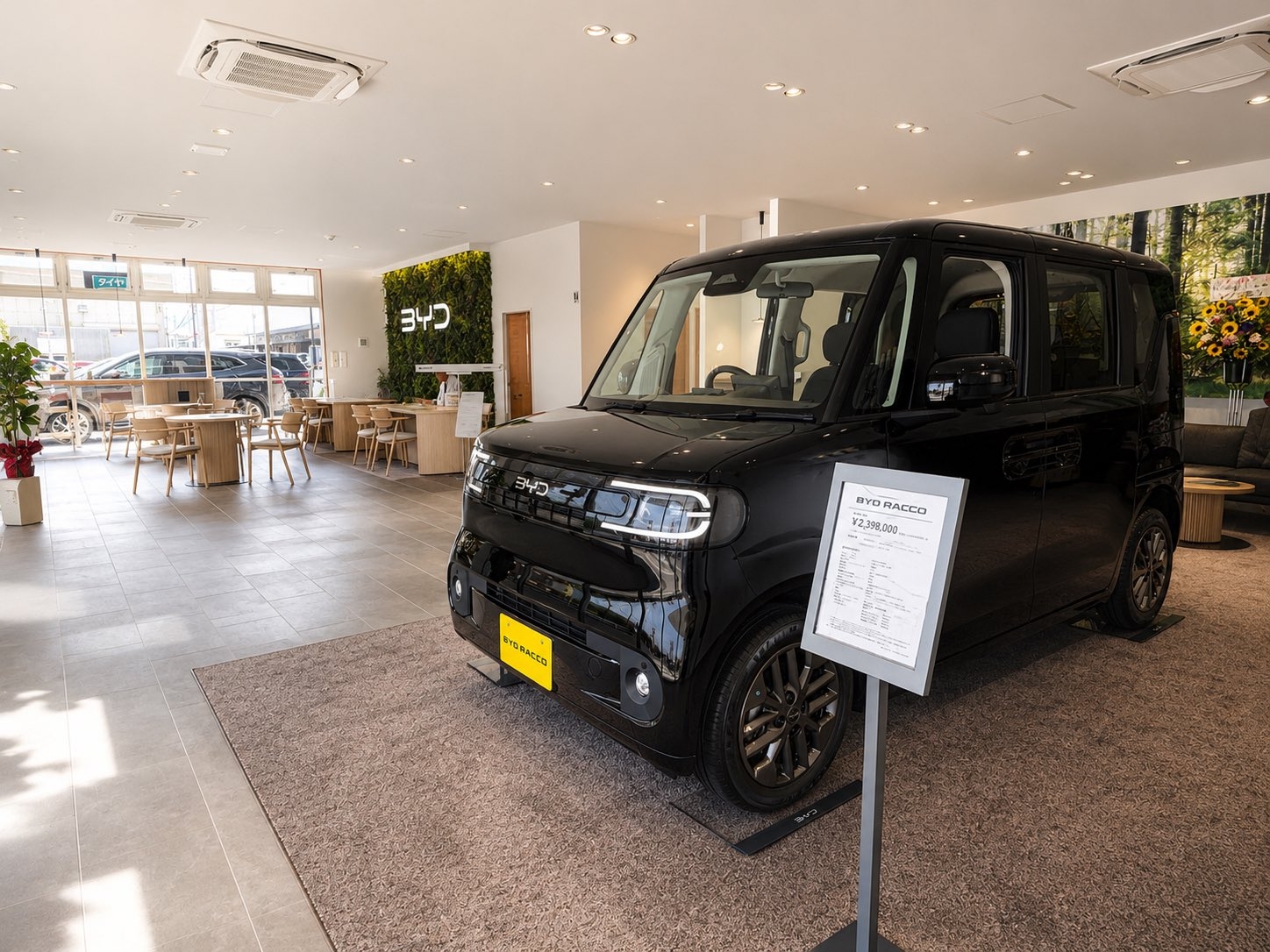
BYD’s Racco, a kei-class electric vehicle developed specifically for the Japanese market, has gained strong early traction following its launch.
Since opening pre-orders on July 21, the model has secured more than 5,000 confirmed orders in its first week. BYD Japan aims to reach cumulative orders of 10,000 units by the end of 2026.
Racco made its debut at the 2025 Tokyo Motor Show, where it attracted 30,000 expressions of interest during its initial appearance.
Market feedback suggests that Racco has generated significantly stronger attention than BYD’s previous models introduced in Japan.

Some dealers reported receiving more than 200 customer visits per day at physical showrooms, with high-performing stores recording around 60 deposit orders in a single day.
More notably, Racco’s buyers are not solely first-time EV customers.
According to BYD, around 70% of initial reservation holders are existing Japanese K-Car owners replacing their vehicles, while approximately 30% are households purchasing the model as a second car.
This indicates that Racco is targeting Japan’s mature mini-vehicle replacement market rather than relying only on consumers seeking to try new energy vehicles.

The vehicle officially went on sale in Japan this Tuesday, offering two battery-range versions and three trim levels, with a tax-included starting price of 2.145 million yen ($13,100).
After applying Japan’s 150,000-yen ($916) EV subsidy, the entry-level version’s effective purchase price drops to 1.995 million yen ($12,670).
Japan’s K-Car market has long been dominated by domestic manufacturers.
According to data from the Japan Light Motor Vehicle and Motorcycle Association, sales of mini passenger vehicles reached around 1.3 million units in 2025, accounting for roughly one-third of Japan’s new vehicle market.
Suzuki, Daihatsu and Honda hold the majority of this segment, while overseas automakers have historically struggled to establish a presence in the category.
The arrival of Racco marks BYD’s first direct entry into one of Japan’s most domestically oriented automotive segments.
Compared with traditional K-Car models, electric powertrains, lower operating costs and intelligent features are key elements of BYD’s strategy to compete in this market.

Previously, BYD’s overall scale in Japan remained relatively limited. Data showed that BYD sold 3,870 passenger vehicles in Japan throughout 2025.
This means Racco’s first-week orders have already exceeded the brand’s total annual sales in the country last year.
According to data from the Japan Automobile Importers Association (JAIA), BYD Japan registered 2,334 passenger vehicles in the first half of 2026, up 42.7% year on year.
Among them, the plug-in hybrid Sealion 6 contributed 1,254 units and became a major driver of sales growth.
With Racco joining its lineup, BYD is adjusting its Japan strategy from an initial focus on pure electric vehicles toward broader coverage across powertrain types and market segments.
By the end of July, BYD had 56 official sales outlets in Japan. Including additional sales locations, its network reached 77 sites, covering all 47 prefectures across the country.
Although this remains below the company’s previous target of establishing 100 stores by the end of 2025, BYD’s retail network continues expanding toward regional cities where demand for compact vehicles remains strong.
Discover more from ChinaEVHome
Subscribe to get the latest posts sent to your email.