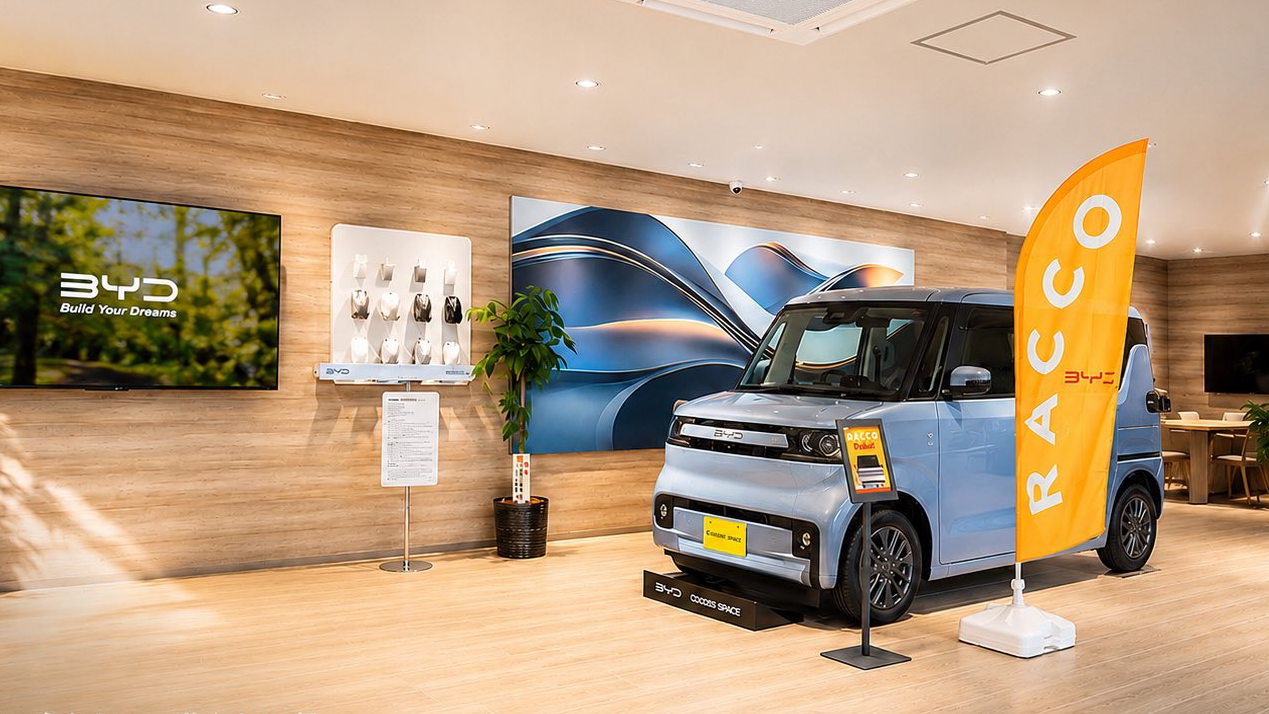
- BYD prices Japan-specific K‑Car Racco at JPY 2.145M ($13,100) before tax and nets a JPY 150,000 subsidy.
- Racco undercuts Nissan Sakura by about JPY 458,600 ($2,800) after subsidies to target budget urban buyers.
- Two battery options deliver WLTC ranges of ~210 km (22.4 kWh) and ~320 km (35.84 kWh).
BYD Japan officially launched its first K-Car model developed specifically for the Japanese market, the Racco, on July 28.
The new model is priced at JPY 2.145 million ($13,100) before taxes and qualifies for a JPY 150,000 ($916) Japanese government EV subsidy.

Following its launch, the Racco will compete with popular domestic models including the Nissan Sakura, Honda N-Box and Suzuki Spacia.
K-Car, a unique vehicle segment in Japan, has long played an important role in urban mobility due to government regulations on vehicle dimensions and preferential tax treatment.
For comparison, the Nissan Sakura starts at JPY 2.4486 million ($14,955), making the BYD Racco JPY 458,600 ($2,800) cheaper than the Sakura after subsidies.
The Racco made its debut at the 2025 Tokyo Motor Show and adopts the boxy design commonly seen among Japan’s mainstream K-Car models.
The vehicle measures 3,395 mm in length, 1,475 mm in width and 1,800 mm in height. It features a four-door layout with rear sliding doors and can accommodate up to four passengers.

In terms of powertrain, the Racco is available with two battery options.
The entry-level “200” version is equipped with a 22.4 kWh battery pack and offers a WLTC-rated range of around 210 km.
The higher-end “300” version uses a 35.84 kWh battery pack with WLTC range extended to 320 km.
BYD’s launch of the K-Car is not simply an expansion of its overseas lineup, but reflects the company’s efforts to further tailor products to the Japanese market.
BYD officially entered Japan’s passenger vehicle market in 2022, introducing its first model, the Atto 3 (known as Yuan Plus in China).
The company has since gradually expanded its Japanese lineup with models including the Dolphin, Seal, Sealion 7 and Sealion 6.

Its lineup covers both battery electric vehicles (BEVs) and plug-in hybrid electric vehicles (PHEVs).
In terms of market performance, BYD remains in an early growth phase in Japan.
Data from the Japan Automobile Importers Association (JAIA) showed that non-domestic brand imported new vehicle sales in Japan totaled 117,896 units in the first half of 2026, down 3.5% year on year.
Imported EV sales continued to grow for the eighth consecutive year, reaching 19,862 units and accounting for 17% of total imported vehicle sales, up 5 percentage points from the same period last year.
During the same period, BYD Japan sold 2,388 vehicles, up 40% year on year.

The Sealion 6 became the company’s main growth driver, with first-half sales reaching 1,254 units, accounting for more than half of BYD Japan’s total deliveries.
However, the Japanese market remains challenging for overseas automakers due to high entry barriers.
Local consumers have traditionally favored domestic brands, especially in the compact vehicle segment, where Honda, Suzuki and Nissan have established strong sales networks and customer bases.
BYD’s decision to launch the Racco, a model specifically developed around Japanese consumer needs, reflects its strategy of using locally adapted products to expand its presence in the market.
Discover more from ChinaEVHome
Subscribe to get the latest posts sent to your email.

.jpg)
