- CATL snapped up a 24.87% stake in Qiyuanxin Power for RMB 2.556 billion to accelerate its truck battery-swap push.
- Qiyuanxin controls 55% of China’s heavy-duty truck swap market with over 1,800 stations and 28,000 trucks.
- Qiyuanxin’s heavy liabilities contrast with CATL’s strong cash and profits, making the buy strategic and low-risk.
CATL has acquired a 24.8726% stake in Shanghai Qiyuanxin Power Technology Co., Ltd. from China Power International Development for about RMB 2.556 billion ($380 million), officially becoming a shareholder of the heavy-duty truck battery swapping company.
China Power International Development previously announced on July 16 that it would sell its entire stake in Qiyuanxin Power through the Shanghai United Assets and Equity Exchange, with a minimum listing price of RMB 2.556 billion ($380 million).
The transaction was completed just over one month after the stake was listed, indicating that CATL had already identified the asset as a strategic opportunity.

Founded in 2020, Qiyuanxin Power is one of China’s early movers in the heavy-duty truck battery swapping sector.
Its business covers battery swap station construction and operations, smart energy services and green transportation solutions.
The company’s core business model is based on “vehicle-battery separation,” which separates battery ownership from vehicle ownership to reduce upfront costs for new energy heavy-duty trucks and improve fleet operating efficiency.
Qiyuanxin Power has built more than 1,800 charging and battery swap stations nationwide, covering 78.5% of prefecture-level cities.

It has also developed more than 100 heavy-duty truck battery swap routes focused on long-haul logistics scenarios.
The company currently holds a 55% market share in the battery-swapping heavy-duty truck segment.
It supports 105 vehicle manufacturers and 731 battery swap truck models, with more than 28,000 battery-swapping heavy-duty trucks deployed.
However, Qiyuanxin Power has faced financial pressure in recent years.
Financial data shows that the company generated revenue of RMB 9.525 billion ($1.42 billion) in 2025, with net profit of RMB 356 million ($53 million).
During the same period, total liabilities reached approximately RMB 20.244 billion ($3.01 billion), resulting in a relatively high debt ratio.

In the first four months of this year, the company recorded revenue of RMB 2.448 billion ($364 million), net profit of RMB 190 million ($28 million), and total liabilities of approximately RMB 20.041 billion ($2.98 billion).
China Power’s decision to sell its stake was mainly driven by business restructuring and capital allocation considerations.
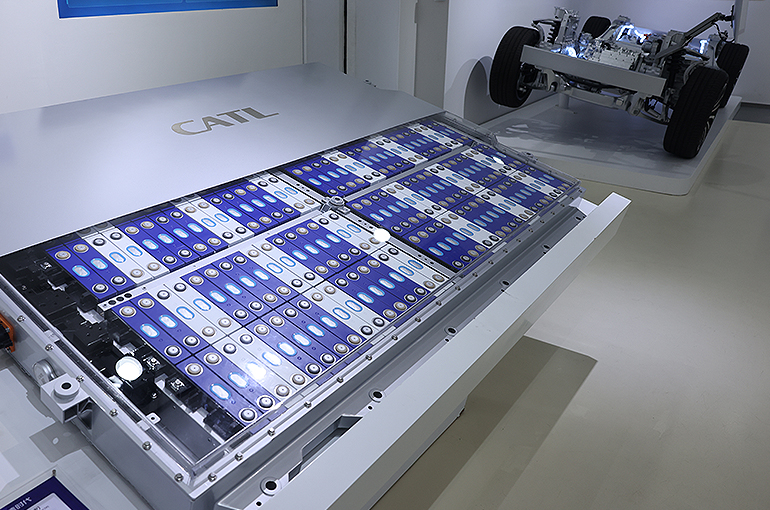
For CATL, acquiring Qiyuanxin Power provides access to an existing battery swap network and customer base.
This also strengthens its connection between power batteries, swapping infrastructure and commercial vehicle operations.
In recent years, CATL has continued expanding its heavy-duty truck battery swap business.
Its Qiji battery swap brand is increasing its swap station network and plans to build a cumulative 900 stations by 2026, with a target of covering around 80% of China’s long-haul transportation demand by 2030.

From CATL’s financial perspective, the acquisition is unlikely to create significant pressure.
In the first half of 2026, CATL reported net profit of RMB 43.284 billion ($6.44 billion), up 42% year on year. Cash and cash equivalents reached RMB 372.053 billion ($55.36 billion) at the end of the period.
At the policy level, large-scale adoption of new energy heavy-duty trucks has become a key focus of China’s green and low-carbon transportation transition.
China’s Ministry of Transport and 10 other government departments have previously proposed increasing the penetration rate of new energy heavy-duty trucks to 40% by 2030, while supporting the construction of 3,000 heavy-duty truck charging and battery swap stations.
Discover more from ChinaEVHome
Subscribe to get the latest posts sent to your email.