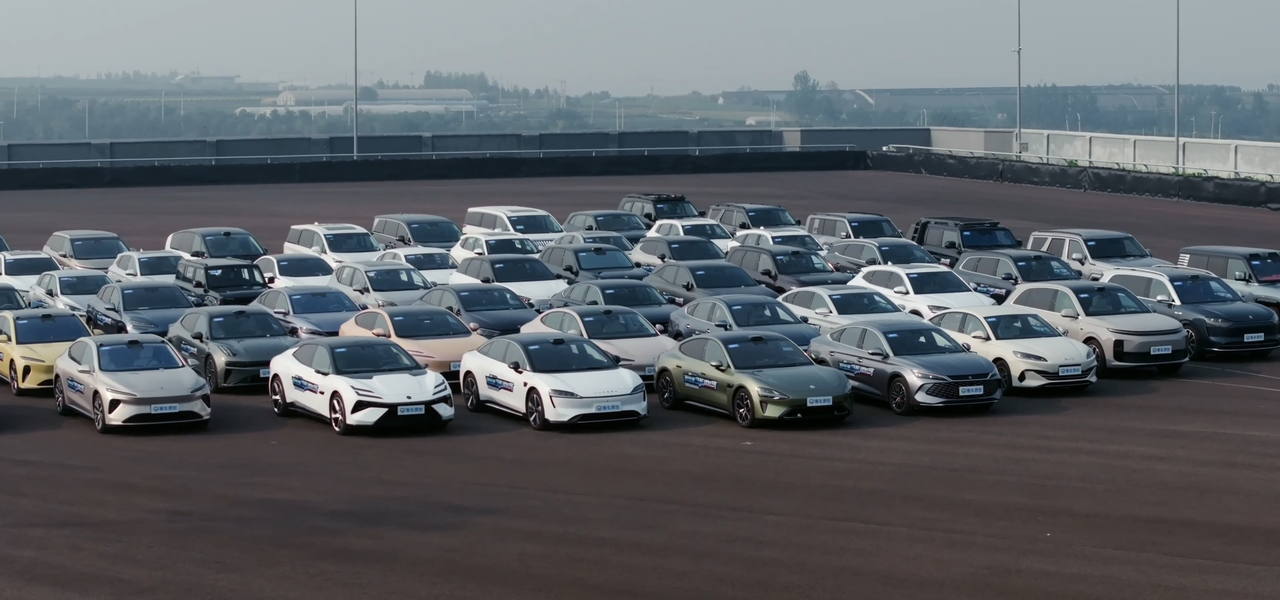
An ultra-stringent test reveals the true range performance of more than 60 EV models.
On August 11, Yiche officially released the final results of the “2025 New Energy Extreme Range Test.”
The test was conducted at the Zhongya Tire Testing High-Speed Ring Track, which measures 5.3 km per lap. The specific rules required each vehicle, fully loaded with passengers, to maintain a constant 120 km/h in Sport mode, with regenerative braking set to minimum or turned off, and the A/C set to AUTO at a constant 22°C. The test ended when the vehicle could no longer sustain 120 km/h.
Unlike the idealized range figures used in automakers’ promotional materials, this test simulated the scenarios EV owners worry about most during long highway trips—winter heating, summer cooling, and high-speed cruising under high energy consumption.
| Rank | Model | MSRP (k USD) | Measured Range (km) | Avg. Energy Consumption (kWh/100 km) |
|---|---|---|---|---|
| 1 | Xiaomi SU7 | 34.43 | 457.7 | 20.60 |
| 2 | Yangwang U7 | 87.92 | 415.3 | 31.97 |
| 3 | Zeekr 007 | 32.19 | 408.3 | 24.25 |
| 4 | Xiaomi YU7 | 46.19 | 393.4 | 25.85 |
| 5 | Hycan S9 | 62.97 | 391.7 | 25.53 |
| 6 | Li Auto i8 | 44.77 | 378.0 | 25.87 |
| 7 | BYD Han L | 33.57 | 376.1 | 21.90 |
| 8 | Zeekr 7X | 37.78 | 366.1 | 27.04 |
| 9 | Rising Auto R7 | 47.57 | 366.0 | 27.32 |
| 10 | Audi Q6L e-tron | 55.97 | 356.8 | 29.99 |
| 11 | Geely Galaxy E8 | 25.03 | 355.8 | 20.93 |
| 12 | Tesla Model Y | 42.49 | 350.9 | 22.34 |
| 13 | Tesla Model 3 | 32.97 | 345.9 | 17.89 |
| 14 | XPeng P7+ | 27.97 | 344.9 | 22.12 |
| 15 | NIO ET9 | 113.12 | 329.3 | 30.06 |
| 16 | Avatr 06 | 34.99 | 329.2 | 21.25 |
| 17 | BYD Tang L | 40.57 | 329.0 | 30.55 |
| 18 | NIO EC6 | 58.24 | 328.5 | 30.14 |
| 19 | AITO M9 | 79.77 | 319.1 | 31.34 |
| 20 | ONVO L90 | 41.97 | 278.5 | 30.22 |
In the pure EV category, the Xiaomi SU7 Pro topped the chart with a tested range of 457.7 km, 42.4 km ahead of the runner-up BYD Yangwang U7. The Zeekr 007 ranked third with 408.3 km.
Other popular models included the Li Auto i8 at 378 km (9th place). None of NIO’s models broke into the top 20; the best performer, ET9, achieved 329.3 km (21st place). The NIO EC6 ranked 25th (328.5 km), while ONVO L60 and L90 ranked 30th and 33rd with 299.4 km and 278.5 km respectively.

In range retention rate, the XPeng MONA M03 led with 65.1%, followed by the Nissan N7 (63.1%) and Roewe D6 (61.6%).
Only five models recorded a retention rate below 50%—the LUXEED R7, XPeng P7+, Wuling Binguo, Firefly, and ICAR V23.
In the extreme energy consumption category for pure-electric sedans, the XPeng MONA M03 again ranked first with 16.76 kWh/100 km, followed by the Roewe D6 (16.83 kWh) and Tesla Model 3 (17.89 kWh).
Compared to other popular single-motor sedans, the Xiaomi SU7 was slightly more efficient than the Avatr 06, BYD Han L, and XPeng P7+, ranking 14th with 20.6 kWh/100 km. The larger NIO ET9 crossed the 30 kWh threshold with 30.06 kWh (23rd place), followed by the BYD Yangwang U7 at 31.97 kWh.

In the pure-electric SUV segment, which attracted more flagship models, the top three were ONVO L60 (19.84 kWh), Deepal S05 (20.28 kWh), and BYD Sealion 05EV (20.92 kWh).
The Tesla Model Y ranked 6th (22.34 kWh), while the often-compared YU7 fared worse, taking 8th place with 25.85 kWh. Right behind was the Li Auto i8 (25.87 kWh), while its direct rival ONVO L90 ranked 14th at 30.22 kWh.

As with Dongchedi’s earlier autonomous driving test rankings, this range list sparked debate.
The main point of contention was energy consumption—some argued that Yiche’s highway range test primarily measured aerodynamic efficiency, meaning the ranking doesn’t necessarily reflect the quality of the EV’s battery, motor, and electronic control systems. Most top-ranked cars had low-drag designs, while those with ~30 kWh consumption were mostly traditional SUV shapes like the NIO ET9, ONVO L90, and AITO M9.
Others countered that the results are still more useful than CLTC range figures, since most drivers care more about range during long highway trips, making this stringent test a valuable real-world benchmark.
Discover more from ChinaEVHome
Subscribe to get the latest posts sent to your email.