December saw diverse new electric vehicle filings in China, with notable models from Nissan, Audi, and BYD.
December’s final batch of new-model filings with China’s Ministry of Industry and Information Technology arrived more abruptly than in previous years.
Beyond the unexpected timing, the December catalog spans a remarkably diverse lineup, covering popular offerings across high, mid and entry price segments.
This year has also shaped up to be a notable rebound period for joint-venture brands.
Alongside the N6 and N7 sedans, Nissan is adding the all-new NX8, a fresh NEV SUV. SAIC Audi, meanwhile, is stepping up with the E7X, a full-electric SUV in the mid-to-large class.
Higher up the price ladder, ultra-luxury marques Yangwang and Lotus are also debuting new entries. The Lotus ELETRE returns in a new plug-in hybrid configuration under a fresh name: FOR ME.
In the mainstream family-car segment, momentum remains strong.
The long-rumored Wuling Starlight L, a six-seat SUV, finally appears, and BYD is introducing what may become its most important volume model for 2026—the Qin MAX.
With one major launch after another, the outlook for China’s 2026 NEV market looks increasingly dynamic. Expectations begin now.
Nissan NX8
Nissan has been one of the fastest and most aggressive joint-venture players in electrification this year.
Barely a year after the N7’s debut and just as the N6 hits the market, Nissan is rolling out the mid-size NX8 SUV—offered in both full-electric and range-extended variants.

Dimensions are nearly identical between the two: 4870×1920×1680 mm, a restrained footprint comparable to the Xpeng G6.
Curb weight is rated at 2119–2160 kg for the EV and 2045–2080 kg for the range-extended version.

The EV will use a 215 kW motor and LFP batteries supplied by Hubei Dongyuxinsheng— a joint venture between Sunwoda and Dongfeng Motor.
The range-extended NX8 carries a 195 kW drive motor paired with a 1.5-liter, 109 kW generator. Wheel choices include 18/19/20 inches for both variants.

Battery options for the range-extended version include 20.3, 21.1 and 37.4 kWh packs, offering electric-only ranges of 102 or 185 km. Battery capacity for the BEV has not yet been disclosed.
Given its brand positioning, size and performance, the NX8 is likely to target the same RMB 150,000–200,000 ($21,200–28,300) segment as the Xpeng G6 and BYD Song Plus, focusing on the five-seat NEV SUV market.
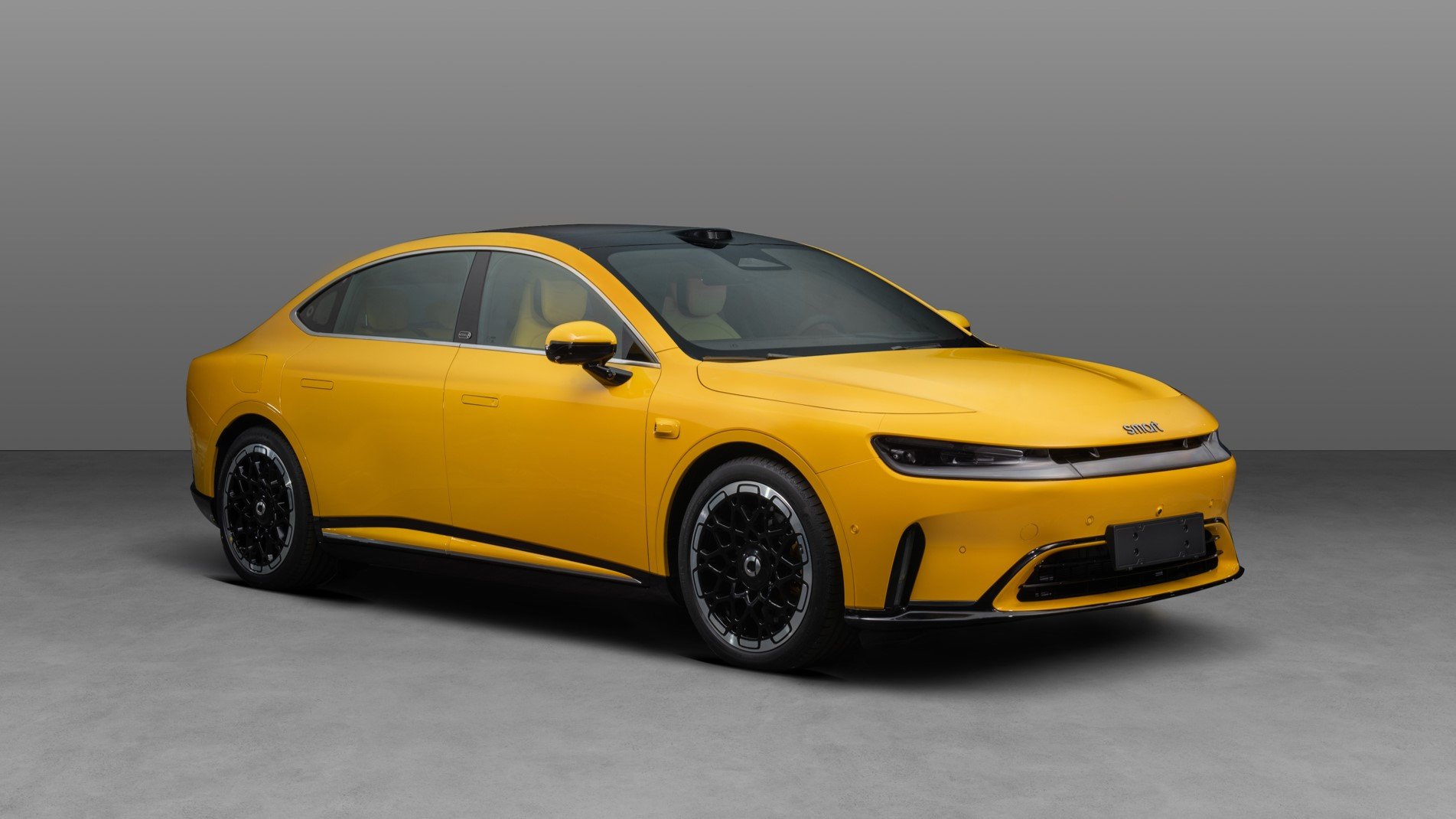
smart Elf 6
The long-anticipated smart fastback has arrived, launching directly as a plug-in hybrid—the Elf 6 EHD.

The Elf 6 EHD sets a new size record for the brand, stretching to 4906×1922×1508 mm—over 10 cm longer than the NIO brand’s ET5—qualifying it as a mid-to-large sedan.

Despite its size, weight remains controlled at 1990 kg. Buyers can choose between 19- and 20-inch wheels and an optional rear spoiler.
Power comes from a 1.5-liter engine rated at 120 kW; motor output has yet to be disclosed.

Battery filings list 20 kWh and 41.46 kWh packs, delivering 110 km and 234 km of electric-only range, respectively.
Smart’s shift toward larger, more premium-leaning vehicles signals a decisive break from its “small-car” heritage in favor of a “refined-for-its-class” positioning. Whether consumers embrace this new direction remains to be seen.
Lotus FOR ME
Lotus is presenting its third production model, nicknamed online as the “plug-in ELETRE” and officially named FOR ME.

Still a mid-to-large SUV, FOR ME measures 5103×2019×1630 (1636) mm—nearly as long as a BMW X7 and roughly as wide as the Zeekr 9X. Curb weights are 3055 kg and 3080 kg.
Its Curb weights are 3055 kg and 3080 kg. Wheel options span 20–21 inches with tire setups of 255/285 or 265/285 front-to-rear.

Its powertrain is a major highlight: a 2.0-liter, 205 kW engine from Aurora Bay Technology—matching the output of BMW’s 2.0T used in the X5.
A dual-motor AWD setup will also be available, though motor outputs have not been disclosed.
Lotus has filed a 70 kWh ternary pack sourced from CATL-Geely, delivering electric-only ranges of 345 km or 355 km depending on wheel size.

The FOR ME’s launch is prompting speculation that Lotus may be moving toward more attainable price points.
Its market positioning will soon become clear once the plug-in performance SUV formally debuts.
SAIC Audi E7X
As SAIC Audi’s second model under the “AUDI” banner, the E7X arrives with almost no prior leaks.

Based on the MIIT filing photos, the E7X carries over styling cues from the earlier E5 Sportback, including the brand’s “Star Crystal Light Curtain” design theme; the rear design also closely matches the E5 Sportback.

As an SUV, the E7X features bolder, more muscular lines. It measures 5049×1997×1710 mm with a 3060 mm wheelbase—significantly larger than the E5, hinting at a higher market position.
Additional specifications include digital rear-view mirrors, wheels up to 22 inches (likely 21-inch standard), and a 300 kW single-motor option.
The dual-motor version pairs a 200 kW front motor with a 300 kW rear motor.

A rare four-seat configuration also appears in the filings—unusual for mainstream SUVs.
The battery is an NCM pack from CATL. Based on the E5 Sportback, 800-V high-voltage architecture is likely, and the roof-mounted lidar suggests support for advanced assisted-driving features, presumably supplied by Huawei.
Wuling Starlight L
In a departure from Wuling’s usual naming logic, the newly filed “Starlight L” is an SUV—while the earlier hot-selling Starlight is a sedan.

In short, the Starlight L is a “large six-seater,” powered by a plug-in hybrid system with a 1.5T engine available in 78 kW and 105 kW configurations.
Its dimensions are 4980×1930×1760 mm with a 2950 mm wheelbase—quite substantial.

Design-wise, the Starlight L bears little resemblance to its “Starlight” siblings, adopting a boxier, more utilitarian look that emphasizes practicality.
Optional equipment includes a single-camera front sensing system, suggesting possible support for basic highway NOA capabilities.

Industry bloggers claim the Starlight L may launch with a surprisingly low starting price—potentially becoming the most affordable large six-seat SUV available today.
IM LS8
As its name implies, the IM LS8 is positioned slightly below the LS9, likely priced between the LS6 and LS9—targeting the RMB 280,000–300,000 ($39,600–42,400) range.

The MIIT photos show a design that partly echoes the LS9 while being boxier and more rugged than the LS6, creating a notably different visual presence.

Key dimensions—5085×2000×1807 mm with a 3060 mm wheelbase—place it squarely in the mid-to-large segment. Five- and six-seat layouts are available.
The model uses a range-extended powertrain (presumably the “Star” super range-extension system) with a 114 kW generator. Output varies by drivetrain: 230 kW for 2WD and 160 + 230 kW for AWD.

A range of optional equipment is listed, including variants without lidar—suggesting that entry trims may rely solely on vision-based ADAS.
Optional extras include electric side steps and a half-spoke steering wheel.
GAC HYPTEC S600
Without any prior leaks, GAC’s HYPTEC (previously named Hyper) S600 abruptly appears in the MIIT filings.

The photos indicate a mid-to-large SUV with styling that differs significantly from the previously spied A800 prototype.
The S600 avoids the popular full-width light bar, instead adopting split, irregular headlights. Both PHEV and EV versions feature closed front fascias.

It also adopts a fastback SUV silhouette, with more emphasis on sleek body lines.
Dimensions are 5015×1933×1685/1700 mm, with a 2936 mm wheelbase.
Wheel options include 19 and 20 inches, suggesting a market position near the Xiaomi YU7 and Zeekr 7X.

The PHEV version uses a 1.5T engine rated at 118 kW with an LFP battery.
The BEV variant has a 250 kW motor and offers either LFP or NCM battery packs. Only four wheel designs are listed.
BYD Qin MAX
After a five-year hiatus for the Song MAX, BYD is once again introducing a “MAX” suffix model.
The Qin MAX measures 4866×1880×1495 mm with a 2820 mm wheelbase—33 mm longer than the Qin L DM-i, with identical width and height.

The “Qin Ultra” and “Da Qin” badges suggest BYD aims to create a performance-focused sub-line within the Qin family.

According to MIIT filings, the Qin MAX offers two motor options, with the top version reaching 240 kW—equivalent to 327 hp—the most powerful in Qin history.
It is a full-electric model powered by an LFP pack from Fudi Power, though capacity is not yet disclosed.

The Qin MAX’s sibling, the Seal 06 EV, also appears in this batch.
The Seal 06 is 4 mm longer and differs in exterior design, while sharing core performance specifications.
Voyah Taishan 8
Like the IM LS8, Voyah is expanding its lineup shortly after the Taishan’s debut, introducing the slightly smaller Taishan 8.
Notably, Taishan 8 is only one of its names; filings also include “Taishan M” and “Taishan E.”

The model measures 5200×2025×1814 mm with a 3090 mm wheelbase.
Unlike the original Taishan, the Taishan 8 drops the large chrome-heavy grille in favor of a body-color treatment, further clarifying its positioning. The rest of the styling remains closely aligned.

Taishan 8 will use a range-extended setup with three battery options, offering electric-only ranges of 190, 300 and 310 km.
The 190 km version uses an LFP pack, while the other two feature NCM batteries.

The generator is a 1.5T unit producing 110 kW. Badging indicates support for Huawei’s QianKun ADAS suite.
Voyah appears to be preparing Taishan 8 as a model to sustain interest following the flagship “9 Series,” targeting the RMB 300,000–350,000 ($42,400–49,500) large-SUV segment against the AITO M8 and Li Auto L8.
Geely Galaxy M7
Instead of releasing a downsized M9, Geely’s latest filing reveals the Galaxy M7.

The model measures 4770×1905×1685 mm with a 2785 mm wheelbase—nearly identical to the Galaxy L7 except for length.
Its silhouette also closely follows the L7, but adopts the more upright, mature design language of the M9—effectively extending the M-series look downmarket.

The M7 uses a PHEV system with a 1.5-liter engine producing 82 kW.
Two LFP battery options deliver 101 km and 155 km of electric-only range.

Based on its size and specifications, the M7 is likely aimed at the RMB 110,000–130,000 ($15,560–18,400) compact SUV segment, positioned between the BYD Song Pro and Song L DM-i.
Geely also appears intent on leveraging the success of the M9 to revive momentum for the Galaxy L7.
BYD Yangwang U8
Two years after its initial debut, the Yangwang U8 reappears in the MIIT catalog.
Its dimensions—5319×2050×1930 mm with a 3050 mm wheelbase—remain unchanged from the current model.

The newly filed U8 continues to use four 220 kW electric motors, delivering roughly 1,200 hp in total, paired with a 2.0-liter turbocharged engine rated at 272 hp.

This strongly suggests the update is a minor facelift, with several exterior options from the U8L now being made available on the standard U8.
According to MIIT information, the refreshed U8 will offer an all-black “Black Warrior” appearance package, along with gold badges and trim elements—previously exclusive to the U8L—applied to the logo, rear badge, mirrors and rear window.
These revisions focus mainly on cosmetic customization.

A new version of the Yangwang U8L has also been filed. Core specifications and color schemes remain consistent with the current model, indicating a light mid-cycle update.
Despite the modest changes, the U8 and U8L continue to hold a considerable technical lead in the million-yuan new-energy off-road segment.
The incremental updates and expanded option packages appear aimed at offering buyers more customization choices rather than altering the vehicles’ fundamental positioning.
Discover more from ChinaEVHome
Subscribe to get the latest posts sent to your email.

.jpg)
