He Xiaopeng and his AD team set a “performance wager”: by August 2026, Xpeng’s VLA in China must match the on-road experience of Tesla’s FSD V14.2 in Silicon Valley.
Xpeng Motors CEO He Xiaopeng has made another trip to Silicon Valley to test Tesla’s latest FSD V14.2 and the company’s Robotaxi service, roughly a year after his mid-2024 drive of an earlier FSD version.
The new round of testing, lasting about five hours, was benchmarked directly against last year’s experience.
According to He’s sharing on Weibo, Tesla’s FSD has advanced from what he described as a “smooth but still L2-like” experience more than a year ago to a level now approaching quasi-L4 stability.

Both the standard Tesla vehicles and Robotaxi units ran on the same model, he said, delivering largely consistent behavior.
While some details still require refinement, the overall performance, in He’s assessment, marks a substantial leap from last year.
The comparison has further solidified He’s view of the industry’s future technical path. He argued that personal vehicles and Robotaxi fleets will ultimately be built on the same autonomous-driving system and hardware stack.

He also expects consumers to bypass the L3 stage entirely, gaining L4-capable features directly on mass-production vehicles.
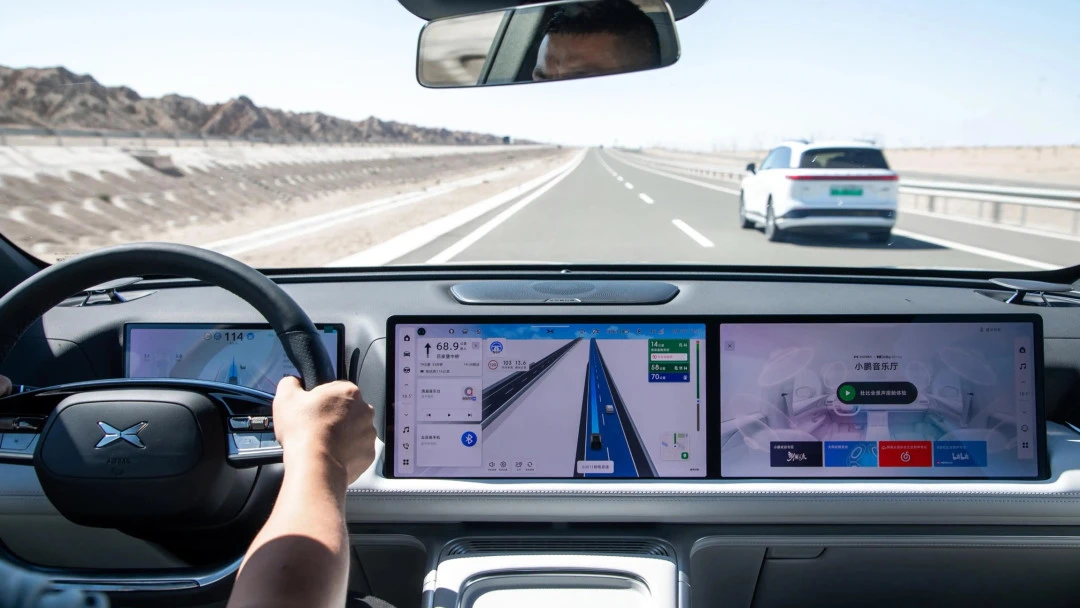
Regarding Xpeng’s own progress, He conceded that the first release of VLA 2.0, limited by development time, is not yet able to match the full capability set of Tesla’s FSD V14.2.
Even so, he has defined a clear performance goal with the autonomous-driving team: by the end of August 2026, Xpeng’s VLA must deliver an overall domestic road experience equivalent to what FSD V14.2 achieves in Silicon Valley.

He also publicly attached a wager to the goal: if Xpeng meets the target, he will build a Chinese-style canteen in Silicon Valley modeled after the cafeteria at Xpeng headquarters.
If VLA falls short, Xpeng’s head of autonomous driving, Xianming, will carry out his pledge to “run naked across the Golden Gate Bridge.”
At Xpeng’s 2025 AI Day in early November, the company formally launched its second-generation VLA system.
The first co-creation experience for pioneer users is scheduled for late December, and a full rollout of VLA 2.0 to the Xpeng Ultra series is planned for the first quarter of 2026.
Xpeng is also advancing commercialization of Robotaxi operations. The company plans to introduce three Robotaxi-dedicated models and begin trial operations in 2026.