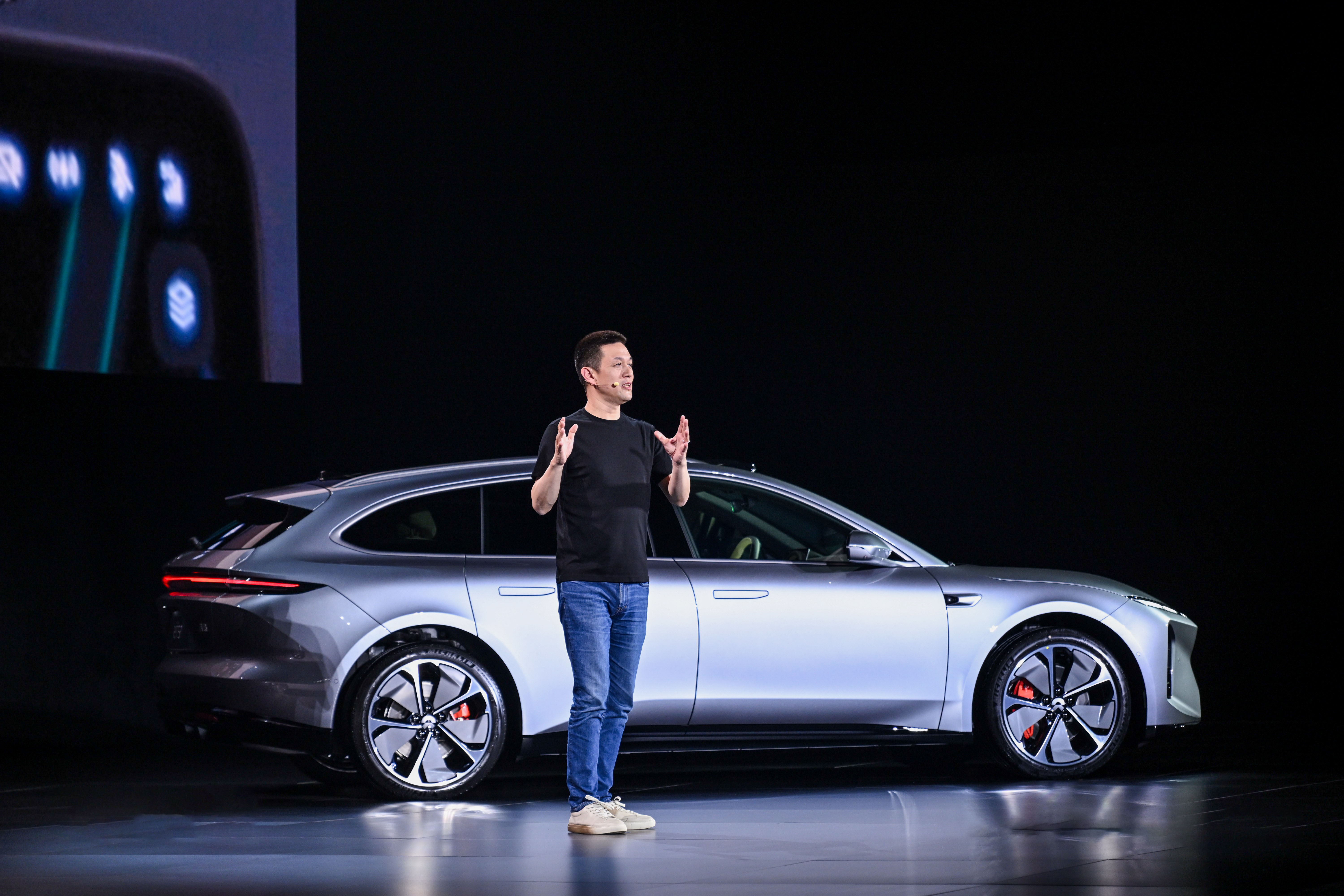
May 25 – NIO officially unveiled the 2025 ET5/ET5T, with prices starting at ¥298,000 for battery ownership models and ¥228,000 under the Battery-as-a-Service (BaaS) subscription plan, with monthly battery rental fees starting at ¥728.
To cut to the chase: The 2025 ET5/ET5T refresh pushes the boundaries of a mid-cycle update. Beyond retaining the NT2 platform’s powertrain, nearly every functional, configurational, and experiential aspect—from cabin ergonomics to software integration—has been meticulously refined.

In fact, the engineering effort invested in this NT2 refreshes rivals that of developing an entirely new NT3-based sedan. Examples include:
- Structural redesigns for the HUD integration and Shenji computing chip architecture;
- Seat reconstruction to enhance comfort;
- Hardware innovations like upgraded CDC dampers, top-mount bushings, subframe bushings, and audio systems.

Notably, NIO has never adjusted MSRP during past model refreshes over its eight-year history. Instead, it incentivizes sales through battery-swap benefits, financial packages, and inventory discounts—a tradition maintained for the ET5 series.
However, facing an increasingly fierce (even brutal) competitive landscape in the ¥300,000+ pure EV segment, NIO must navigate unprecedented marketing challenges. Its refusal to slash prices—a move aimed at protecting brand equity and existing owners—demands extraordinary strategic finesse.

Does the ET5/ET5T truly deliver best-in-class value as a ¥300,000-tier pure electric sedan/wagon?
500 Upgrades
William Li said that the whole-vehicle renewal rate of the dual-5 models in this mid-cycle change has reached 45%, with over 500 vehicle upgrades.

However, first of all, there are not many changes in the appearance of the dual-5 models.

After all, the current model already has a very classic design, especially the ET5T. The 2025 model mainly makes improvements in the lower half of the vehicle, making the overall look more robust. For instance, the lines on both sides of the front face and the new-style diffuser on the rear side.

Obvious external configuration upgrades mainly come from ADB digital headlights that align with higher-end models and newly designed 20-inch low-drag wheels.

In terms of color, a new option called Far Sky Purple has been added, along with Moonlight Silver inherited from the new ET7 and dual-6 models. I personally like the combination of ET5T and Moonlight Silver, as it resembles the Audi RS4 Avant.

Upon entering the vehicle, the dual-5 models naturally upgrade to the same cabin as the ET9 and dual-6 models, with refreshed color schemes.

The refreshed components mainly consist of a 15.6-inch dual-layer OLED center console screen, an 18.8-inch W-HUD, NOMI 3.0, an optional stream media rear-view mirror, and the same new-style stalk shifter+steering wheel design. The instrument panel remains unchanged this time.

The dual-layer OLED center console screen needs no further introduction. The same material as the ET9 ensures a sense of luxury. Moreover, the 15.6-inch center console in the shorter and narrower dual-5 vehicle doesn’t appear small. Instead, the ET9 feels a bit spacious in comparison.

The restructured internal space of the vehicle’s front end allows the dual-5 to accommodate an 18.8-inch W-HUD, which is 0.6 inches smaller than that of the dual-6. Engineers say this is the limit for the dual-5 as a sedan, but the overall viewing experience remains excellent.

Additionally, while it may not be of high importance to the 5T, it is still highly recommended for ET5 owners to opt for the stream media rear-view mirror. This mirror utilizes an 8-million-pixel auxiliary driving camera and the Shenji image enhancement. The advantage of image quality is one aspect, and NIO has also implemented a high-speed automatic digital focal-segment change function.

The adoption of the stalk shifter brings dual 50W air-cooled fast charging, which can normally activate Xiaomi’s proprietary protocol (pre-mid-cycle NT2 NIO models tested at a maximum of Xiaomi 30W).

As a real-life owner of the 5T: In fact, the audio experience has always been a relatively weak part of it compared to its price range.

This time, the dual-5 models have been upgraded to a new audio hardware system with 23 speakers and support for 7.1.4 surround sound channels. Additionally, the Dirac Pro tuning algorithm from the ET9 has been introduced.

Combined with the further enhanced NVH performance this time, the dual-5 models’ audio system, when compared horizontally with luxury sedans in the 300,000-yuan price range, is no longer a shortcoming and is even relatively excellent.
NOMI, the soul of the NIO cabin, has been updated with a new software capability called the “charging assistant” to coincide with the launch of the dual-5 models. Based on big data capabilities, it can provide more detailed long-distance charging and swapping options.

Compared to the cabin, the riding experience is a distinctive feature of the Dual-5 facelift.
The seat structure of the Dual-5 has been completely reengineered. Upgraded to 11 layers, it adds a 20mm comfort sponge layer and NIO’s proprietary 15mm NIO-AIR sponge layer.
The headrests are also upgraded, with larger areas at the front and back, and a micro-concave curve. The rear seat gets a 15mm soft foam layer and a 6° increase in recline angle.

The front-seat lumbar support is lowered by 30mm. For taller 5T owners who previously needed an extra lumbar cushion, the new version now offers near-natural support.

The seat cushion features a zoned design on both sides, increasing contact area by 20%. The rear-seat effective support length is extended by 75mm, and optimized front-seat under space allows passengers to place their feet more relaxed.

In addition to the seat upgrades, seat functions are enhanced. Ventilation, heating, and massage features are improved. Our tests show significant advantages in ventilation and massage over luxury cars in the same price range.
As the Dual – 5 is often used for daily commuting, NIO has made sun-protection upgrades.
The ET5’s panoramic roof is upgraded to 1.28 square meters, close to the 5T’s 1.35 square meters. The ET5’s roof now includes an infrared-blocking layer, claiming to block 99.9% of UV and 99% of infrared radiation, reducing infrared radiation by 50%.

For both Dual-5 models, front side windows now use laminated glass with an infrared-blocking layer, blocking up to 99.9% of UV and 85% of infrared radiation, with a 90.4% infrared energy blocking rate, a 50% improvement over regular laminated glass.

Moving on from sensory upgrades to driving enhancements, the vehicle’s center of gravity is optimized-483mm for the ET5 and 499mm for the ET5T. Tests indicate the ET5T has a slightly lower handling limit.

The Dual-5 receives 29 suspension-related hardware upgrades, resulting in a more “comfortable, stable, and tight” feel. These include optimized front and rear spring stiffness, anti-roll bars, 14 bushings, and hydraulic bushings on the rear subframe.

New users will particularly value the standard CDC damping control system, featuring 1,000 adjustments per second. This brings the 4D Comfort Lead function, previously exclusive to models 6, 6, 7, 7, 8.

According to William Li, chassis upgrades translate to a 23% increase in bump-impact softness, 15% better smoothness on rough roads, 17% less bounce on undulating roads, and 30% less shake when crossing speed bumps at low speeds. Tests confirm reduced tug when crossing bumps and less looseness after speed bumps, giving the car a more luxurious feel.

EP Mode is also reworked, with red-and-blue color schemes now in ambient lights and available as a permanent theme.

A new “mountain-running mode” is introduced, offering mountain-road route planning, recommendations, and group support. Soon, we might hear “a group of ET5s coming down the mountain.”

In terms of driving range, the new Dual-5 sees comprehensive optimization. Take the 75kWh battery as an example: ET5’s range reaches 585km, while ET5T’s is 550km.

Moving on to intelligent driving, NIO’s world model is set to launch, with the new point-to-point assisted-driving function rolling out in June. NIO’s parking assistance will also be enhanced, improving casual parking, remote parking, and intelligent parking-trajectory planning.

Equipped with the Shenji chip, the new Dual-5 gains image enhancement like the ET9, with notable improvements in brightness and clarity.

Price-wise, the Dual-5 starts at 298,000 yuan, or 228,000 yuan with BaaS. All models come with ADB headlights, 18.8-inch W-HUD, and CDC damping control.

For a limited time, buyers get a 9,500-yuan comfort package for free, including 240 battery-swap vouchers over five years, AC charging (or a 5,000 – yuan option fund), five years of NOP+, and a 6,000-yuan EV-purchase subsidy. These perks match those of the Dual-6.

Finally, are the feature-rich yet price-stable Dual-5 and Dual-6 appealing to you?
The Deep End: A Stern Test
In 2025, new-energy vehicle makers enter a new battleground of mid-cycle facelifts.
Neither NIO nor Li Auto is refreshing the powertrain for their main models this year. NIO’s L series and NT2 platform remain distinctive, and the new-energy vehicle market in China is still highly competitive.
For NIO, pure electric vehicles over 400,000 yuan used to be like the last tough math problem in college entrance exams. But in 2025, pure electric vehicles around 300,000 yuan will also face many upgraded models, such as those with a 400 – km range and 5C fast charging, bringing intense competition.
For various reasons, NIO has to rely on the NT2 platform for another year. While battery swapping is a big advantage, the short-term absence of the NT3 platform makes NIO’s long-term strategy less strong.

The ET5 and ET5T have been delivered over 170,000 times so far. They have made their mark in China’s premium pure – electric sedan market. As key commercial products for NIO, they are expected to sell better.
Whether the “Dual 5” models can break through the market remains to be seen from their delivery volumes.
Discover more from ChinaEVHome
Subscribe to get the latest posts sent to your email.
[…] Midsize BEV Car: NIO ET5/ET5T […]
[…] have been largely confirmed, including the flagship sedan ET9, refreshed versions of the ES6, EC6, ET5, and ET5T, as well as ONVO’s first three-row model, the L90, and Firefly’s debut […]