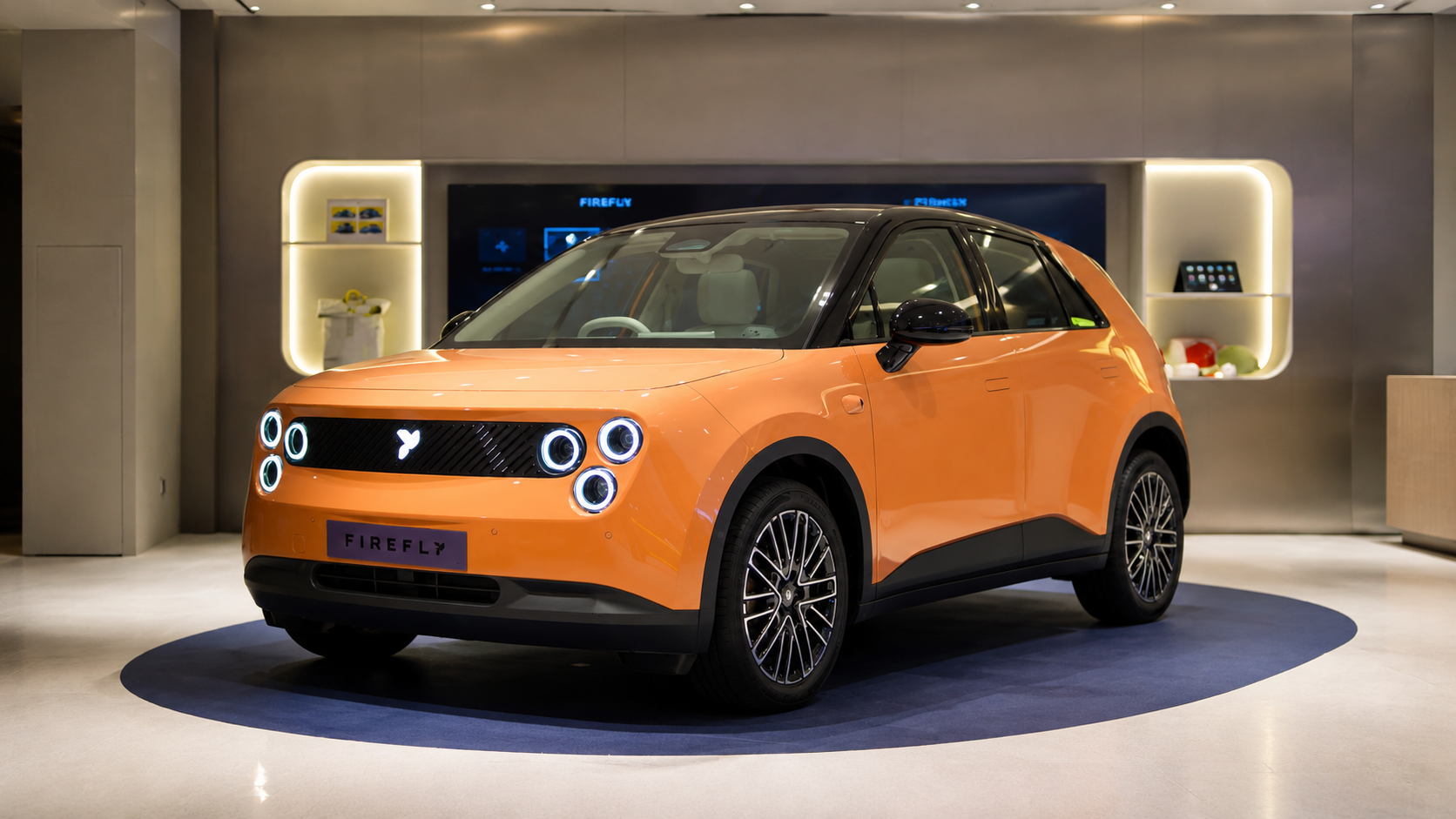
The Firefly’s production plant has reached full capacity, with deliveries in August expected to set a new record.
On July 29, the latest results from the China Insurance Automotive Safety Index (C-IASI) were released. The Firefly achieved a G (Good) or higher rating in all four categories, making it the first small car to earn G+ ratings across the board in C-IASI history.
Public records show that only three models have ever achieved such a result in C-IASI evaluations: the Firefly, the ONVO L60, and the AITO M9.
Here are the Firefly’s final safety ratings:
- Crashworthiness and Maintenance Economy Index: G
- Occupant Safety Index: G+
- Pedestrian Safety Index: G+
- Active Safety System Index: G+

Official data shows that the average length of vehicles evaluated by C-IASI is 4807mm. Among vehicles that achieved all-G ratings, none were shorter than 4500mm—making the 4003mm-long Firefly the smallest vehicle among the 161 models ever tested by the agency.
It’s worth noting that C-IASI’s new testing protocol is significantly more demanding. The newly introduced G+ grade requires a G rating in all subcategories.
Additionally, the protocol includes new crash test scenarios such as the front passenger-side 25% offset crash and a front 50% offset crash. Side-impact crash severity has also been raised, with the barrier mass increased from 1500kg to 1650kg. These changes place even greater demands on vehicle materials and structural system design.
This makes the Firefly’s final G+ ratings all the more significant.

The Firefly’s safety credentials stem from revolutionary structural design at the platform level. The body uses a high-strength steel and aluminum alloy mix accounting for 83.4% of the material, achieving an impressive torsional stiffness of 35,700 Nm/deg—setting a new benchmark for small car chassis strength. Additionally, the Firefly comes standard with 9 airbags across the lineup, including an innovative dual-chamber far-side airbag, which provides comprehensive side-impact protection from the A-pillar to the C-pillar.
In terms of active safety, the Firefly is equipped with Horizon Robotics’ Journey chip solution, offering 128 TOPS of computing power and 24 high-performance perception sensors. The system supports 13 active safety features, including AEB (Autonomous Emergency Braking).

Since deliveries began on April 29, over 10,000 units have been delivered within just three months.
Last weekend, brand marketing head Pu Yang revealed that Firefly has fully resolved its production bottleneck and is now capable of delivering vehicles within three weeks. Following the release of its BaaS (Battery-as-a-Service) policy, customer interest in the Firefly has surged. Currently, the factory is operating at full capacity, and August deliveries are expected to hit a new high.
Discover more from ChinaEVHome
Subscribe to get the latest posts sent to your email.