- Epicland is exploring a battery-swap variant for its second model to stand out in the Huawei ecosystem.
- CATL’s growing “chocolate” swap network and supplier ties give Epicland a practical path to launch swap versions.
- Adopting battery-as-a-service could strip battery costs from price and lower the X9-class purchase threshold.
Domestic media reports say Epicland, the new EV brand jointly created by Dongfeng and Huawei, is weighing a battery-swap version for its second model; the project remains in the pre-research phase.

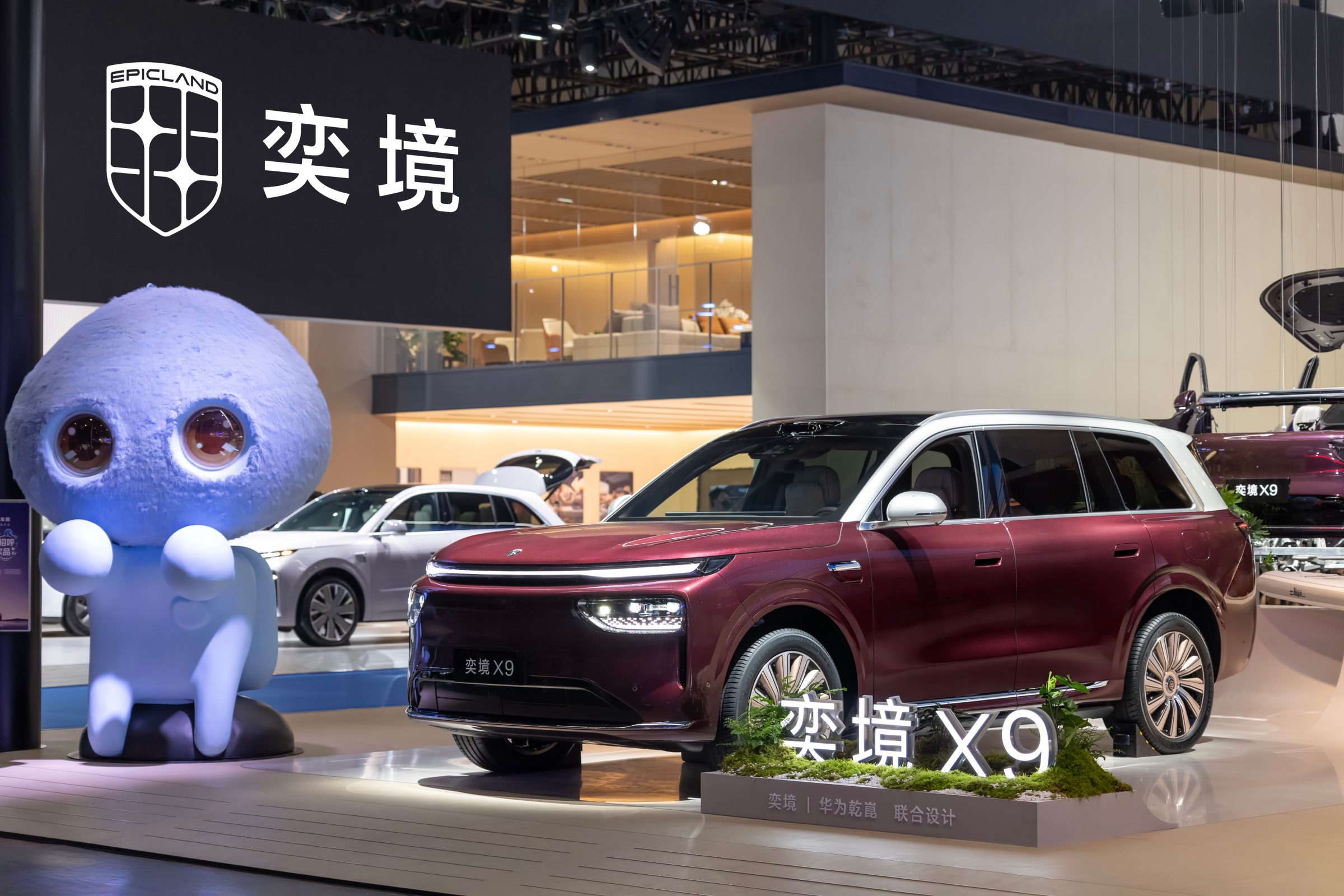
Previously, Epicland’s first model, the X9, opened pre-orders.
The new vehicle is a full-size six-seat SUV; measures over 5.3 meters long; spans a wheelbase over 3 meters. All versions pack the Huawei Qiankun ADS 5 and HarmonyOS Cockpit. Pre-sale price ranges from RMB 299.8K ($44.6K) to RMB 379.8K ($56.5K). After 24 hours of pre-orders, intended orders exceeded 21K.

For Epicland, battery swapping may be a card for differentiation within the Huawei automotive ecosystem.
Currently, several Huawei-backed models already pack similar Qiankun ADS 5 and HarmonyOS Cockpit 6. As smart driving and smart cockpits gradually become common configurations among Huawei partner models, energy replenishment has also become an important direction for Epicland to seek product differentiation.
The advantage of battery swapping is first reflected in charging efficiency.
NIO’s fourth-generation swap station can complete a swap in about 2 minutes and 24 seconds; CATL’s v claims a fastest swap time of about 99 seconds.

Meanwhile, Epicland also has potential conditions to join the swap system. CATL is one of Epicland’s main battery suppliers; also a major player in China’s swap market.
As of the end of June 2026, CATL had deployed about 2K chocolate battery-swap stations nationwide, covering 180 cities; plans to raise the national total to over 3K stations by the end of 2026.
More importantly, battery swapping may also reshape Epicland’s pricing model.
Through battery-as-a-service, battery costs can be stripped from vehicle prices, lowering the purchase threshold. For a large SUV positioned around RMB 300K ($44.6K), this may also be a way to expand its price coverage in the future.

In addition, CATL recently started cooperating with local SOEs to expand the swap network; accelerating its own station rollout.
As swap infrastructure continues to improve, if Epicland ultimately adopts the swap solution, it could leverage CATL’s expanding network to achieve the launch of a swap version with relatively low investment.
Under Epicland’s previous plans, the brand will launch three new models in 2027. If one adopts the swap solution, Epicland could build a new product differentiation label beyond Huawei’s smart driving and smart cockpit.
Similarly, SERES’ new brand AIVA is also discussing battery-swap cooperation with CATL; its first model, the ME7, is also expected to join the chocolate battery-swap system.

On the swap track, Epicland and AIVA share the same strategy; both hope to use energy replenishment differentiation as a key variable to counter homogeneous competition.
Discover more from ChinaEVHome
Subscribe to get the latest posts sent to your email.