Recently, the debate between LiDAR and vision-based solutions has reignited, with the battlefield extending directly to the AEB (Automatic Emergency Braking) active safety domain. Zhao Zhelun, former Intelligent Driving Product Director at Li Auto, and Candice, Senior Director of Autonomous Driving Products at XPeng, engaged in a public dispute over AEB capabilities.
The controversy began when Zhao Zhelun stated on social media that current pure vision-based vehicle models haven’t achieved mass-produced AEB braking capabilities exceeding 100km/h.

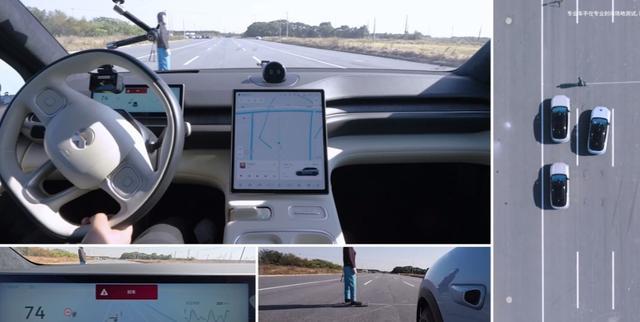
Candice immediately countered by releasing a test video demonstrating dynamic braking at 100km/h, claiming XPeng’s pure vision AEB already achieves vehicle braking at up to 130km/h while emphasizing significant improvements in active safety target recognition and environmental adaptation.

The core of their disagreement lies in testing standards. Zhao emphasized that the industry’s standard 120km/h braking test refers specifically to “host vehicle at 120km/h approaching stationary vehicle” scenarios, whereas dynamic rear-end scenarios (e.g., preceding vehicle moving at 60km/h) involve only 60km/h relative speed – posing entirely different perception system requirements. This distinction matters because Yuan’s demonstration video showed AEB activation in dynamic vehicle-to-vehicle scenarios on highways.

As the LiDAR vs. vision-based AEB debate intensified between Li Auto and XPeng, Harry_AD, NIO’s Intelligent Driving Product & Experience Director, joined the discussion with a late-night essay reflecting on real-world active safety implementation.
Harry_AD NIO’s technical evolution: from increasing AEB response speeds while distinguishing effective speed from maximum braking speed, to expanding detectable targets by integrating GOD (General Obstacle Detection) into AEB for non-standard obstacles like cardboard boxes and traffic cones, then extending detection range/angles through end-to-end models achieving 270-degree forward coverage.

However, Harry_AD acknowledged current track testing evaluations remain unreliable: “Even 20 successful track tests don’t guarantee real-world reliability, nor can they accurately measure false activation rates.” He advocated focusing on practical safety value, citing NIO’s 25.2% reduction in average owner accident losses through active safety upgrades last year, and their “Safety Value Sharing Program” linking safety performance to insurance premiums.
This debate unfolds as China completes drafting mandatory national standards “Technical Requirements and Test Methods for Automatic Emergency Braking Systems of Light Vehicles”, requiring all new M1 passenger vehicles and N1 light trucks to equip AEB systems by June 30, 2025.

Ultimately, AEB technological competition matters less than actual accident reduction – users care about real-world safety, not flashy PPT statistics.
Discover more from ChinaEVHome
Subscribe to get the latest posts sent to your email.